Page 49 of 312

No Greater Love

In the name of the Easter season I’ve been spending some time in John’s Gospel story. I have to be in the right mood for Johnny. He gets all sentimental with flowery love language, telling his version of the story in a bit of an unusual way, compared to the other 3 accounts (called in the academic world the “synoptic Gospels”).  I like the directness of Mark – he moves through the story as if it were a trip to the mall. “And then we, and then we, and then we...” And  Matthew’s rich history underwritten into his texts. And Luke the Equalizer and his love for the poor and downtrodden. So, John is more the Love Child of the gospel stories and thus when I need to get out of the business of religion, I turn to his words.

Specifically, I love his writings on Jesus’ pre-death soliloquy. Chapter by chapter, you can’t read it in one sitting – it’s much too rich. Chapters 14-17 are best in small bites. Today’s nibble that caught me was 15:13.

[box] “Greater love has no one than this, that one lay down his life for his friends.”[/box]

Now, I’ve always identified more as the one who received the love that cost life. Jesus died for me, so I’m receiving the Greatest Love. What a gift. Thank you Jesus, you shouldn’t have. I need to write a thank you note.

But today I dug out my 8th grade English skills and diagrammed this verse and realized I’ve been reading it all wrong. It’s hard in our murky English language with misplaced modifiers and gender-neutral language to completely understand it, but I’m fairly positive I’ve understood it backward.

While, yes, the beloved friends in the verse do reap benefit, they’re not experiencing the Greatest Love. That warm fuzzy is a mere bi-product. The Greatest Love goes to “the one” who is giving – giving the love, laying down the life. While we might feel special, we ought not feel as if we’ve achieved the Greatest of all Loves. We’ve simply been in relationship with one who has.

In our love-hungry culture, we frequently appeal to this desire to be loved. Look at our books and movies and find the undercurrent story of being pursued as the ultimate expression of love. I never watched it, but I believe 50 Shades appealed to a large audience because it played the strings of this desire to be the object of such a love. Christians, be careful – much of our language around dating, specifically for women, sings the same song. Be pursued. Wait patiently. It’s all very knight-in-shining-armor-y.

This narrative distorts the Greatest Love and leaves us hungry. When we devour romance novels and porn we taste something similar, but like saccharin, are not fulfilled. We’re dining on the wrong kind of love. We’re chasing a Receiving love. Jesus said we’ll be full when we begin to live a Giving Love.

Perhaps this is why God gave parenting as a gift and a practice. In this space, we’re thrust into Giving Love. We most certainly aren’t the Beloved of the relationship, and for many of us this might be the first time we’ve lost Beloved status. All of a sudden we’re Loving with costs, not just benefits.

Pair that with a culture that tells us that the measurement of our costly love is how our children turn out. Well-adjusted children become the measuring stick of love. No wonder all parents are neurotic. Because we’re seeing it backward. The beauty isn’t only in the Beloved. The real blessing is in the work of Giving Love.

The Easter season ought not be just a time to reflect on how much we are beloved, though we are and the day is a beautiful one to show gratitude. But it should be for us a time of year to focus on how we might be a Giver of love, someone who lays down one’s life.* If we stop at living the Beloved life, we’ll never actually experience the Greatest Love God has to offer.


*I appreciate and believe in the need for inclusive language. However, I also hate it and the way it can muck up a sentence.
My map of life

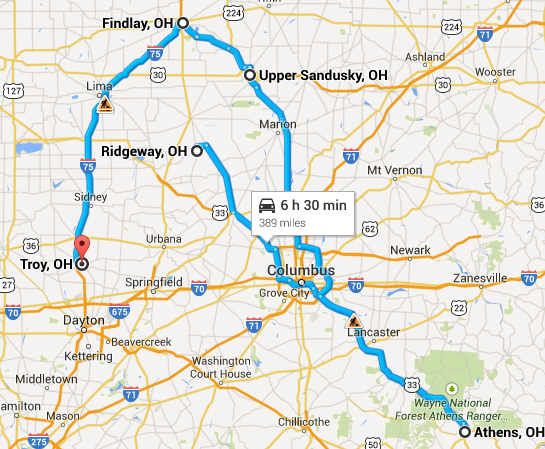
Over the past several years, I’ve mapped the course of my life and the many ways in which I’ve changed as a person. Often, I see the biggest alterations of my inner self  follows the movement of my physical self. When I moved, I changed. Each place in this world is unique, even when you move slightly down I-75. The people are different and, quite often, I am a different person as they greet me.

I began to look at my life through the lens of my geography. Noted: I am not a worldwide traveler. I’ve not made my home outside the borders of Ohio. Yet I find as I trace my path, that each move has changed me, notably for the better. This is not to say that people should move more – there is something to be said for roots. But the geography of my life tells my story.

Ancient cultures did a much better job of this. They would put markers – alters – in the places which were significant to them. Jacob woke from a dream and left a large rock to remember it. Peter, James & John walked with Jesus to the top of a mountain and wanted to build a little shanty so they could keep the vision a reality. I’m no geologist and I tend to sell my houses instead of keeping them for souvenirs, but I do have google maps.

ridgewayI was born and raised in Ridgeway, Ohio. Don’t look very hard on a map – you have to do some significant zooming. The population of my entire home county is pretty puny, until we claim students when Ohio Northern is in session and gain some weight. Small town (and I mean small – you people who live in Findlay and Troy, please take note of the McDonald’s within your city limits*) life suited me. It’s what I knew. I feel as if I should put on my resume the fact that I can list my graduating class in alphabetical order. (Jessica Adams, Alan Ashba, Diane Bettinger, Travis Cronley, Anthony Elsasser…**)

athens

When I made numerous trips from Ridgway to Athens, it took at least 2.5 hours, if not 3. The 33 bypass is a big improvement. Also, not stopping at the 20 Minute McDonalds in Lancaster will shave some time off the trip.

My Ridgemont people launched me into life at Ohio University. Oh, those were beautiful days. The world got big. And small. I learned what friendship looked like (and I must say, ladies, you set the bar HIGH). I fell in love with Jesus. I fell in love with good beer. I fell in love with trees that changed color and green springtimes by the water’s edge. I found my legs in Athens. I had to walk (the hills!) everywhere, I began running for fun. I began walking on my own through life.

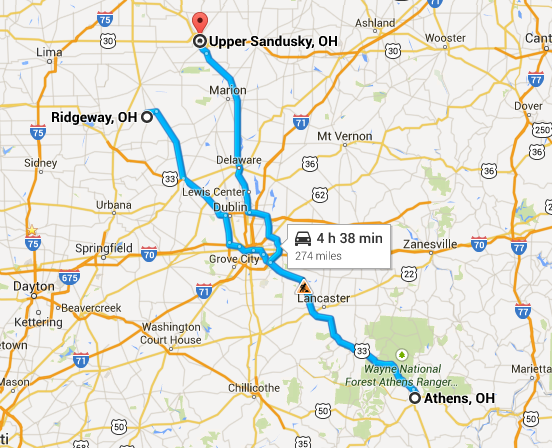
From Athens I headed to Upper Sandusky, answering an ad in the local paper for a need for a youth director. I’m not much into signs and God doing everything while you sit back and get a pedicure, but this really was an act of God. With a college degree and no prospective job, I had resorted to thinking I would have to be a secretary somewhere in Kenton for a short time until I got my act together. I’m pretty sure my parents feared the same thing. But then John Stewart (the church, not the comedian) posted their position.

upperI fell in love in Upper Sandusky. First with a group of 13-18 year old students. And their parents. And KLR. And a few gray hairs in the UMW. And book club. And then with a particular 5’8 former kicker who worked at the funeral home. I learned about love when you lose someone as I grieved with a family and then with a church family. I found my heart in Upper Sandusky.

While living in Upper, I stuck my pinky toe in Ashland for seminary. Oh, that drive at 7am due east into the sunrise. Ashland was a delightful little town and one of my regrets is that I wasn’t present while not in class. Seminary was good to me, one of my best decisions. My God got a lot bigger there.

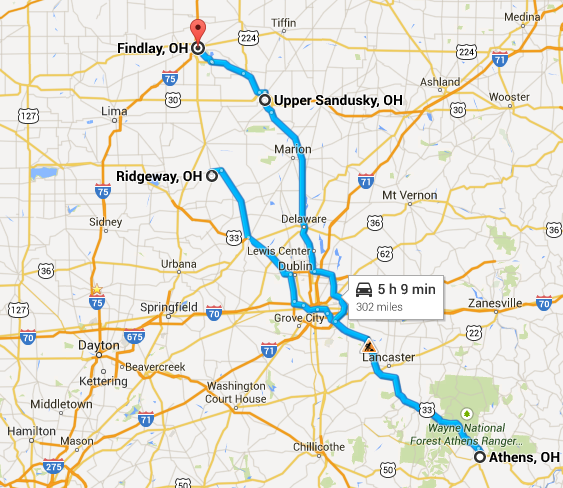
After God got so big and Love got so big, my little heart and head almost couldn’t handle it. I knew it was time to leave my position – mostly because I’ve never done anything for more than 4 years at a time; it’s what young people are trained to do –  and JJ decided to make a change of career and we ended up accidentally-on-purpose buying a house in Findlay. He went to grad school and I got a big girl job.

findlayYou know how at night, deep sleep is important to your brain, so that you soak in all the events of the day and the knowledge acquired gets attached to proper neurons and transmitters and you somehow grow? I found my brain in Findlay.  I recovered from the day in Upper. I slept. (Well, not really, because that’s where we started a family.) I put all the learning and growing up in the right sections of the brain. If Upper Sandusky was shooting me out of a rocket into all the big Love and big God, then Findlay was where I drifted downward in a slow free fall. It was just like the movies, when people freefall in a skydive – slowly at first, delightful as you take in the scene, but as you near the earth the gravity gets stronger and there’s a crash as you hit the water.

That crash was August 1, 2011.

With a two-week-old baby and two toddlers, we were washed upon the shore of Troy, Ohio. I was immobilized. Again, like the movies, it was like arriving on a desert island. With 3 small children. And a husband who ran off to work every day to bring us food. That first year was hard. Nearly awful. I managed to find someone to watch my children so I could work part-time and that dear, precious woman down the street… well, she knew I had no one. She showed me a little more of God when I rattled on about nothingness at pick up and drop off. We went in search of a church home. Three times. I discovered that the primary ways people connect with their community is through work, school and church. I worked remotely, with children too young for school, without a church, so I was largely disconnected.

troyThen we woke up one morning to a few small tribes of people who had stumbled upon our little family washed upon the shore. They made a fire and soup (from homemade broth and locally procured, organic vegetables) and fed us. They sat with us as we warmed and dried. They played with our children. We were invited into the tribes and learned new ways of living.

When Love got bigger and God got bigger and didn’t fit into my heart and head anymore, my people of Troy*** grew my heart and mind. I wasn’t such a strange bird here. I found space for all my big-ness.

In Troy, I have found my voice. My writing and thinking about ALL of the things has became more than mumbling. I have uncovered the things I love to invest in. I have discovered names for the thinks that I thought, like [Jesus]-feminism. I am matching my story, becoming avid proponent of small everything – business, farms, community. Even small people, like when Overfield reinforced my belief that toddlers are people, too. I live as if small changes matter.

Who knew along this path where I would discover my legs, heart, brain and voice? When I started the journey, I didn’t even know I missed them. It makes me wonder when and how I will stumble across the functionality of my hands, liver, and knees. What group of people, in what place will show me how to use those pieces?

According to Google maps, my trip from Ridgeway to the present can be driven in 6 hours and 30 minutes, but it’s taken me 34.5 years to travel it. Perhaps I’m a tad slow. Or maybe I’m just stopping to admire the view along the way of life’s journey. In any case, to those who have walked beside me, thank you.


*Ha! “City” limits. Ridgeway is technically a village and I technically lived outside of it.

**My apologies for adding another listing on Google to whomever just searched these names. They are delightful people. Hire them.

***Trojans, yes?

Hurting those who Help

Back in my youth director days, I often told my students that “for every rule, there’s an idiot.” If you come across what seems to be asinine instructions or common sense direction, the most likely reason they exist is because someone else didn’t know enough to do it that way. I encountered this even more often once I moved to a corporate job – silly protocol because someone wanted to slip past unspoken procedure. Often the way we humans respond is to put a rule in place so that it won’t happen again. When it keeps happening, everyone pays a price. Privileges are removed in hopes for change.

Apparently we need to post a sign in the state of Ohio that says, “don’t say you’re working more or less than you really are and bill medicaid.” And because it keeps happening, we will all pay a price – specifically those who are impacted by independent home health care workers, both those who provide care and the families who rely upon them.

An attempt to control fraud in one of the fastest growing industries deserves applause. However, it was noted (with lousy journalistic fact checking on my part): “From 2010-2014, 479 home care providers were criminally convicted, and independent providers accounted for 306 (~64 percent) of those convictions.” However, we can make numbers say what we want.  These numbers don’t tell the entire story. Independent Provider (IP) fraud cost the state $5.9 million. A lot. YET agency fraud cost the state the same $5.9 million PLUS an additional $2.6 million that the employees of these agencies cost the state. (Source)

We’re dripping millions of dollars and the best solution we can do is to get rid of 13,000 IP healthcare jobs. This seems to be Governor Kasich’s plan. No new IPs will be allowed in and within 3 years all IPs need to find an agency to house them. What’s the harm in this, you ask? Let me introduce you to a few fantastic people.

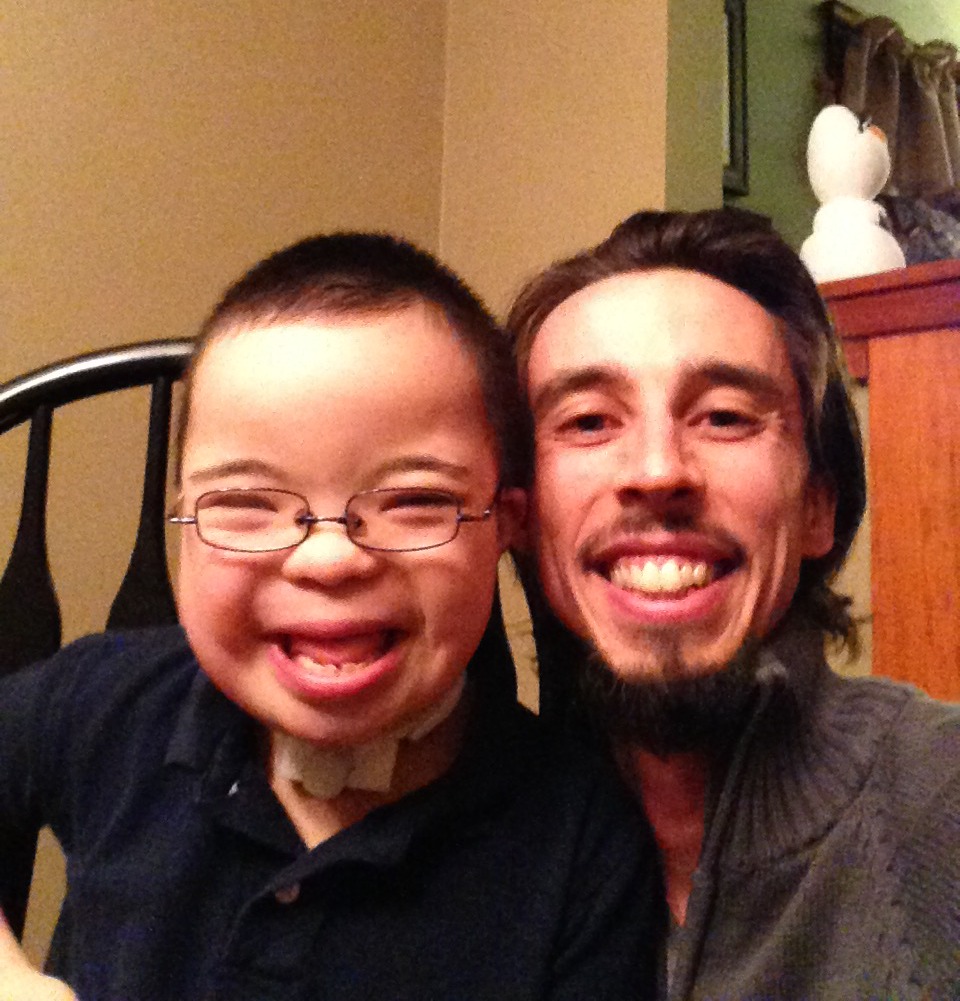
Look at those handsome fellas!

Look at those handsome fellas!

My brother-in-law, Chad, works as an LPN to Gabe, an 8-year-old boy with Down’s Syndrome. Gabe has had a trachesostomy for most of his life and contracted a rare infection prior to Chad’s work with him which left him with a highly compromised airway. Now that Chad also accompanies Gabe to school, he works as an IP for his first 2 hours a day, but is required (by the school) to be an employee of an agency for the 6 hours of care he provides while at the school. Then he returns home for another 1-2 hours as an IP. The payoff to agency oversight? Chad brings home on average $7.17 PER HOUR less than he does as an IP.** For, as it turns out, more work. Because he can’t sit idly by, Chad pitches in with Gabe’s academic needs as well as regular maintenance of his physical condition, learning sign language and ensuring Gabe understands the work before him. (In an ideal world, students like Gabe would receive individualized attention, but it’s simply not feasible in this classroom, like many others.)

Chad is good at what he does – his teachers at nursing school adored him and his grades were the top of his class – and he will likely be able to find an agency to keep working. (For less money and more hours mind you.) However, Gabe’s family may or may not be able to keep Chad. Depending on the different ways that insurance and medicaid coexist, paper-pushers will make the decisions on behalf of the family about who will show up at their door and care for their son.

Two families are making an undesirable situation work. Chad is trying to support a family 6 on a salary which, over the last 5 years of working as a nurse, has went down instead of seeing increased wages based on merit or tenure. Gabe’s family is trying to provide him with someone that treats him with dignity and respect, giving him quality care. Of course, that can exist in a nurse provided by an agency, but an agency itself cannot. And who gets a bigger slice of the medicaid pie? The agencies. Otherwise they wouldn’t exist (and the industry wouldn’t be growing at such an alarming rate.)

How does this happen? Well, both literally and figuratively Gabe has no voice.  Those who require one-on-one care are typically unable to speak out for the ways in which decisions are made on their behalf. Of course, families can advocate – and many are, like the Ohio Consumer Voice for Integrated Care (which is one of a number of organizations trying to bring about change, I am sure).

Yet let us imagine for a moment the life of a family with someone who requires considerable professional care. They also have jobs, groceries, doctor appointments, taxes, soccer practice for siblings and the gazillion other things that you and I complain about every day. Though they may hate what is happening, often they may  not feel able to do one. more. thing.  My friend Ellie shares her story about their journey with daughter, Kate, who requires significant care. I think her words will give more validity to this thought.

So what do we, good citizens, do about it? Tell the people making decisions on your behalf. First, sign this petition. Go ahead. I’ll wait. It opens a new window so you won’t loose your place.

Next, call your representative. I know, I hate phone calls, too. I was involved with a call campaign some years ago when changing the budget (coincidentally, also within Health & Human Services) and when I called they said they had received so many calls, they were no longer writing down names. They heard the message. The specific program I was advocating for was able to keep their place in the budget.

FRIENDS IN HARDIN AND HANCOCK COUNTY: I’m looking at you. Your very own representative, Robert Sprague is the CHAIR of this committee. This means he helps put together the agenda. He’s guiding this team. Tell him the way in which you believe you are best represented. I’ll save you the hassle of googling his number: (614) 466-3819.

I believe I’m about a day late on this, as there was supposed to be a hearing yesterday with public testimony. But no laws have been changed or passed, so there is still time to tell the guys in suits that giving agencies more money (while care providers get less) will not solve their fraudulent woes. New rules that hurt those who are trying to help won’t give individuals better care.

Some of this is new territory for me (and after the birth control debacle of 2014 I wanted to swear off anything political, but I just couldn’t shake this one), so feel free to add changes and corrections in the comments. Supply our good readers with resources and stories.


**Math notes: IPs get a different rate for the first hour they work each shift (base hour). Chad actually gets to charge 2 of these since he works 3 shifts (IP/agency/IP), and even with the added amount of the extra base hour, his average is $7.17 less. LESS! Bonus fact: his agency charges medicaid for the base hour but that difference in pay doesn’t go in Chad’s pocket. He is paid the same for all hours he works. Huh. Agencies seem to be a fantastic solution there.

« Older posts Newer posts »

© 2026 Michele Minehart

Theme by Anders NorenUp ↑