 Did you know that May is Better Speech & Hearing month? Neither did I. But what better time to share a little more of our family’s story of hearing loss, early intervention, child development and education. Much of our learning curve started with diagnosis, but now that we’re venturing into school systems and learning environments, I’m finding myself re-noticing just how much we do have to pay attention to how hearing loss affects our family. Here are a few of the lessons we’ve learned along the way.
1. Hearing loss is manageable, though frustrating at times. Especially in young (pre-verbal!) children hearing loss comes with its own sets of complexities, but we have always approached our situation in a way that recognizes we are among the luckier ones. In the process of a baby’s development from zygote to birth, a million and two things (I slightly rounded down) could go wrong. For 2 of our babies, something did, but we feel we fared well.
2. The right people make the situation better. Our family has been extremely well resourced as we ventured into this gig. My college roomie, a childhood friend and the notorious KLR are all audiologists. They spent extra years of schooling digging around in people’s ears. The day we got the negative hearing test back, I had an entire panel of professionals at my disposal. KLR doubled as an early-intervention specialist, so she had the right people at my doorstep to navigate EI programs and resources. I’m not sure how our story would be written differently without these people to call with questions and air frustrations.
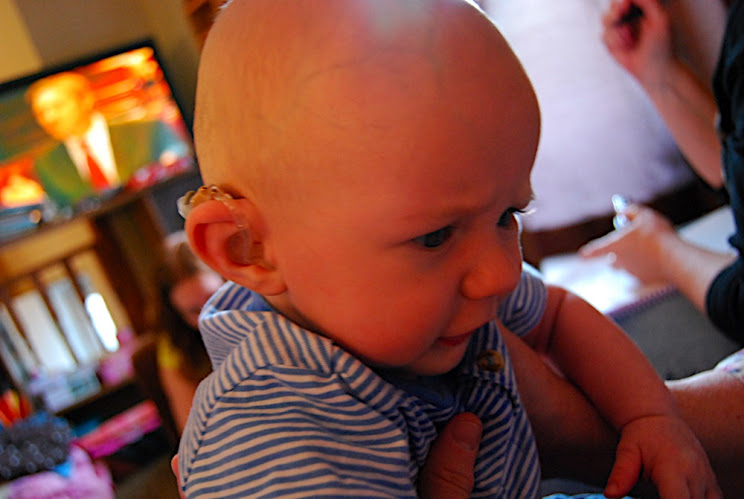
3. Early intervention matters. Both of our babies were tested at birth, which put us months – if not years- ahead of the catch-up game. They were aided by 6 months and 3 months of age, so they spent most of their infanthood hearing sounds that help pattern their brain. That’s a big deal when it comes to how their brains work to recognize sounds. The folks that work in EI need a raise and a hug because they are gifts. We had RIHP Kelly, who came to our house monthly to help us navigate BCMH, practice listening activities, bounce questions or just share frustrations. Just a note: when you complain about taxes, please keep in your mind RIHP Kelly and the many do-gooders who make their programs work from shoestring state budgets. Not all of our social services are going to “deadbeats” who “won’t get a job.” Some of us have been served up a unique challenge and need some help.
H-Boy wearing his first hearing aids.
4. It’s okay to feel the fears. Upon diagnosis, we went through a series of feelings around our children’s futures. We even asked the classic question, “will s/he go to prom?” Finally we answered, “if s/he wants to.” It changed our parenting philosophy that depends less on how others treat our children and more about what kind of person they want to grow to be. I won’t give license for kids to say jerkish things to my kids concerning their ears, but I will teach them to give grace for those who don’t understand, offer education for those who need to change the way they think and challenge them to become like the kind of friend they want by their side. We cannot change others or our life situation, but we can change the way we react to it. This is a life lesson beyond dealing with hearing aids, but I’ve been able to serve it to them at a young age.
5. Hearing loss changes the way we learn. This has been thrown in my face repeatedly this year. Both of my kids have had their aids and wear them consistently, but that doesn’t make them the same as typically hearing kids. They still require eye contact to get their attention. They have to work harder to hear the difference between a V and a B or an M or an N. Learning to read is hard, yo. Add in the fact that it’s dependent upon hearing someone verbally giving you the example… and, well, it can be a tad frustrating. Thankfully we had a patient teacher this year and H Boy is leaving Kindergarten in the early stages of reading and loving it (which was my primary goal. I’d wait until 2nd grade to have him reading if it meant it was an experience of joy rather than hatred). He read me Hand Hand Fingers Thumb yesterday and I could’ve cried with joy. I’m guessing I’ll have an entirely separate post someday as it relates to navigating school systems, IEPs, and working with children who need accommodation to stay head, not get ahead.
6. Hearing loss changes the way we interact. The oldest is a strong type-A, lead the pack, my-way kind of kid. (I have no idea where he gets it.) But at school? He’s quiet, reserved and best in small groups. However, I noticed a marked difference after we got him a new pair of hearing aids mid-year. Until we upgraded, I didn’t give as much thought to how you interact with groups when you may not hear the entire conversation or the exchanges that go on outside of your direct context. Because of this we’re going to work harder at getting both of them an FM system so that he doesn’t have to work as hard at hearing conversations going on around him. Even family members have noticed a marked difference in the way he interacts with his cousins and family beyond his immediate family. He’s opening up, joining in and even initiating conversations.
7. We can teach our children that normal is relative. My typically hearing children don’t find it strange at all that their siblings wear hearing aids – it’s simply one of the many differences among them all. Our experience has made me keenly aware of how my kids interact and understand other disabilities or life situations. I know that in our situation, I would want kids to ask us, or my children, about the hearing aids and have an opportunity to understand better that the differences are fewer than the similarities. I’ve been privileged to journey with like-minded parents who have raised their kids – my children’s friends – to see beyond the little things hanging over ears to see my children for their personality and character.