Page 24 of 312

Beyond a single story

Because I have no brothers, I have no means for comparison. Yet I was raised to believe that with enough hard work, passion and natural skill, there was little I could be turned away from in the world simply because I was born female. My parents never used any of these words; they raised me in a time and place where the common story was one where girls should and could have the same opportunity as the boys.

Even throughout my seminary years, studying in a predominantly white male world, I rarely came up against people who desired to put limitations on aspirations because of the way I was born. (Granted, I made it pretty easy by keeping aspirations low and quiet.) In fact, I came across two guys who legitimized and validated me beyond what was necessary, and I look back now with gratitude.  The primary voice in a place where I was in the minority was welcoming, validating my childhood story.

It wasn’t until I was an adult that I realized the story my parents and my educators had told me about what I could and couldn’t do wasn’t the universal story. There was an incident where I was told, outright, my femaleness that took me out of the pool of opportunity. It was in a place that I wanted to help – I could help. I had the hard work, the passion and the gifts. But, apparently, my vagina was a tad intimidating.

The hurt I felt wasn’t only in the rejection. It was also the startling fact that my prior life story wasn’t the only option. Soon, thanks to the world wide web and gutsy bloggers, I found out that I wasn’t alone. There were parts of the world where the hurt I experienced was the norm. This was the life experience of many women. Their mamas and daddies told them different things about their future based on how they were born.

I was appalled.  My friend KLR and I literally said, “Wait. This is still a thing? An issue?”  I had been raised in a time and a place that said, “well, sure, it used to be this way. But we’re better than that now. We know better and we do better. You have nothing to worry about. Now go on and make yourself the best.” But as a country, as a society, I found out as an adult that we’re not better. For many people, it’s not “used to.” It’s “should.”

The people who had validated me all along were also appalled. They hurt for and with me. But I believe they were shaken to realize their efforts of making society better hadn’t reached their full potential.

There is no single story for any gender, race or orientation. Just because you have an uncle, best friend or college professor who shared his or her experience – and came out just fine – doesn’t mean that the rest of the world is giving the same opportunity. Just because you’ve lived a particular life doesn’t mean life happens the same way for people who share the box you check on registration forms. It is so very, very important to listen to people who are quietly and politely trying to explain that what we perceive as normal is not, indeed, standard protocol.

I’ve been silently watching the eruption of reactions to the recent brutalities against both black men and white cops. It’s all terrible. (Please, world, stop believing we need to choose sides.)

A have a variety of friends who are, or will be, raising black or brown babies. I hear the fear in their response to the obvious inequalities. They’re going to have a different conversation with their children than I will with my blond boys. I empathize and agree, it should not be this way. But another thing irks me: somehow these white women saying the same thing that black mamas have been crying for years suddenly validates this experience to the white world.

Why? Why can’t we believe the black mamas when they say, here’s what I’m teaching my kid about how to dress and respond to a traffic stop. Why is the horror and injustice much more palpable to white ears when said by someone who looks like them?

I feel like this is part of the problem. Somehow this illustrates exactly what those crying for racial equality are trying to say.

It shouldn’t take “one of our own” to convince us that the experience of race, gender and orientation may not be the only story. Perhaps it’s our hopeful optimism that keeps us from hearing that our progress hasn’t reached as far was we believe. We want to think that we’ve done better as a society in seeing the divine spark in all human beings. And when stories inform us that we’re a tad disillusioned, we don’t want to hear it. The gap between what we believe to be and what actually is can be hugely disappointing.

But we need to keep listening. We need to allow the differing experiences of others to be more than a possibility and instead admit we need to put our work boots back on.
A Vision

I read/heard recently that most poets are also prophets; most prophets spoke in poetic prose.  Amen.


From Work Song, in New Collected Poems by Wendell Berry.

2. A Vision

If we will have the wisdom to survive,
to stand like slow-growing trees,
on a ruined place, renewing, enriching it,
if we will make our seasons welcome here,
asking not too much of earth or heaven,
then a long time after we are dead
the lives our lives prepare will live
here, their houses strongly placed
upon the valley sides, fields and gardens
rich in the windows. The river will run
clear, as we will never know it,
and over it, birdsong like a canopy.
On the levels of the hills will be
green meadows, stock bells in noon shade.
On the steeps where greed and ignorance cut down
the old forest, an old forest will stand,
its rich leaf-fall drifting on its roots.
The veins of forgotton springs will have opened.
Families will be singing in the fields.
In their voices they will hear a music
risen out of the ground. They will take
nothing from the ground they will not return,
whatever the grief at parting. Memory,
native to this valley, will spread over it
like a grove, and memory will grow
into legand, legand into song, song
into sacrament. The abundance of this place,
the songs of its people and its birds,
will be health and wisdom and indwelling
light. This is no paradisal dream.
Its hardship is its possibility.

Collecting Stories

I’ve always been a collector of stories. Some schools call that journalism, or, nowadays, blogging, but from the earliest times I can remember, I have loved sitting and hearing the stories of the world around me. Growing up in a hair salon may have fed this inclination. Perhaps this is why I’ve become a voracious reader and a consumer of the interwebs. With each bite I take of a story, I digest it; it becomes a part of me.

It is no surprise, then, that my favorite feast has always been stories of my family. When I was a young girl, I would stay the night with my grandma Mary and grandpa Bill and I simply would not go to sleep until grandma had told me 83 stories of her childhood. The time great-grandpa Gustin made her work in the garden before a big date and then threw tomatoes at her. The time she was a supporting role in Aunt Glenna’s school play, and she would come home from play practice with her, and one evening, a young gentlemen drove them home (in horse and carriage, no less!) and he put his arm around Aunt Glenna. Grandma Mary was aghast! Immediately grandma Mary told the story to the sisters and her parents. An hour later, Aunt Glenna came into her room to threaten grandma Mary “now don’t you tell mom and dad about that boy having his arm around me!” And grandma, the self-proclaimed chicken, lied and said she wouldn’t tell.

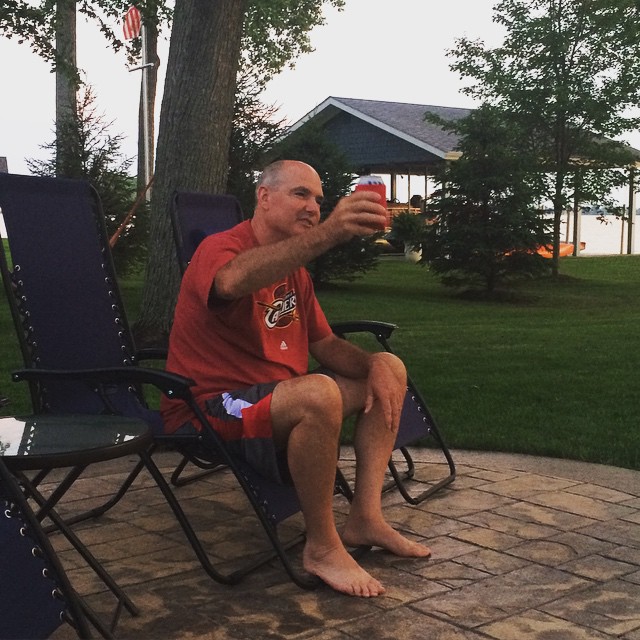
On Saturday night, my mother, my sister and I invited several family members and friends to celebrate my father’s 60th birthday. It was a glorious day at the lake, filled with food, laughter, and of course, stories. Those happen automatically with this group. I’ve never left a gathering without another “remember the time when.”

In our invitation, I asked our guests to come with their best Tom Story. It was mostly a means of saying, “please don’t bring a gift” but I heard from several that they were working hard at bringing their favorite. My wise husband decided these simply needed collected, so he went around asking each person to tell their Tom story on camera and then compiled them all onto one video. W surprised him when we set up a sheet and projector and the whole party sat back to watch the Stories of Tom.

Do you know what I love about stories? They have as much to do with the teller as the subject of the story. So much of life is subjective. Our experiences color the moment. Which, with this particular group of people, adds depth and texture to the stories. These memorable moments connected my father with each person, as if they had been knit together through the hours and days they had shared.

We belong to one another. That’s why we tell these stories. Nothing warms my heart more than to know my father has been woven into the fabric of our community so deeply, so tightly, that no one struggled to tell a story. Tim said, “choosing a favorite Uncle Tom story is like trying to pick a favorite kid.” Everyone has a trove of stories because my dad is, in his nature, a deeply connected person. When he connects with others, he doesn’t stature; there’s little posturing in his way of being with people.

He doesn’t speak from above or below. It’s as if he comes up beside you and wraps an arm around you, much like Aunt Glenna’s secret boyfriend, so you know that you’re loved and included. And then he says something ridiculously funny. His naturally generous nature seeps into his way of life, leading toward a propensity for hospitality. Not only is everyone welcome, but everyone is welcomed. Verbally, loudly, with a beer. And good luck trying to slip out early – he’ll be adamant about one more card game, boat ride, or – “really, just stay for the night and get up early to get where you need to be.”

I’ve noticed a new theme in the stories of my father, now that he has hit the crest of 60 years of age. Where he used to be leading us forward, facing the future, he how tends to walk with his back to that direction, looking at those who follow in his wake, like a guide who intimately knows the land. He has less and less interest at where he is going – because his ultimate destination is assured – and spends his best moments considering the future of the next and the next generations.

Last year on Father’s Day we celebrated at the family lakehouse. We toasted to my grandpa Bill, as my father pointed out and celebrated the foresight he had to invest in our treasured lake spot in 1971. “Did he know we would need this long driveway for the kids to ride bikes and scooters?” I heard him ponder, this past weekend. “How did he know this location on the lake would be so perfect?”

I see my father looking to the wisdom of his father, the way he invested in an unseen, un-guaranteed future with humility. Grandpa Bill didn’t give his boys everything – though there was an incident with new satellite dishes in the 1980s which caused a rift with my mother – but my family legacy is to give the gift of wisdom, the gift of hospitality, the gift of thinking forward. (The family legacy is also the ability to find a way to do it cheaper and better, also known as “Wingfielding that Up.”)

Because we started on a farm – and some of the best stories from the cousins came from riding with Tom in a truck to this field or that – when I ran across a line from poet Wendell Berry, it sung to me.

“So, friends, every day do something
that won’t compute…

…Invest in the millennium. Plant sequoias.
Say that your main crop is the forest
that you did not plant
that you will not live to harvest.”

As we toast to my father’s 60 years on this earth – and to 60 more, I hope – you will find me over here, feasting on the stories. My dad has become a successful man; he lacks little (yet still computes the cheapest way for us to eat at a fast food restaurant. “You might as well get the value meal for the extra $0.65”). It was only with his help that I bought my first car, first house, first anything.

Yet, I would propose, his greatest achievement is the way he loves people and welcomes them. He has left me with a legacy of the importance of good friendships and strong family ties.  He has fed my soul with stories that describe what life on earth is really about: loving people.

Happy birthday, dad.

« Older posts Newer posts »

© 2026 Michele Minehart

Theme by Anders NorenUp ↑