
Page 16 of 312

Looking in empty places

In John’s gospel (chapter 20), within 2 paragraphs of Mary Magdalene finding an empty tomb, Jesus’ first words to the group of the disciples.

Again Jesus said, “Peace be with you! As the Father has sent me, I am sending you.” And with that he breathed on them and said, “Receive the Holy Spirit. If you forgive the sins of anyone, their sins are forgiven; if you do not forgive them, they are not forgiven.”

Why in my 37 years of Easter morning services have I never known what specific directions Jesus gave the disciples? I got the “go and make disciples” messages, and the running to the empty grave and even some stories about not recognizing Jesus on the road. Never once did I know that we had this Forgiveness Mandate put upon our lives.

Previous to Jesus’ announcement, forgiving only happened at the Temple. (Remember that passage where the religious leaders accused Jesus of heresy because he forgave the sins of the man on the mat? “Only God can forgive sins,” they yelled.) To achieve forgiveness status, you showed up at the temple with the appropriate size of bird or mammal, along with a tithe (and remember, the Pharisees were tacking on a tenth of mint and thyme because they were High Achievers). You paid your dues for having Psoriasis to the Temple system and moved on about your life.

And what about when you kept having to give and give to the Temple System because bad things kept happening to you? Like when you spent 3 months locked in your house because your 4 small children caught every bug and virus known to the local school system? The message was clear: You’re not blessed. You’re not on God’s good side, so give a little more.

Those without had even less. Unless you count the heaps of guilt and shame they carried around with them.

Jesus’ message of new life: We the People can forgive. You’re not tied to a suffocating system anymore.

God gave the temple as a means to serve the people. God gave processes, not because he needed the smell of burning heifer to create happiness in heaven. God didn’t need another dead dove or spotless ram from your field. God did, however, need people to walk in a sense of freedom.

And in the absence of a system which restored people to fullness of life, Jesus handed the task to the people. Regular old carpenters and farmers and guys who liked to fish on Sunday.

This passage resonated deeply with me, not just because of the weight and the task ahead of us (ahem: me. I cannot tell you the last time I went around sprinkling forgiveness into my conversation. Who am I to forgive you? That shall remain for another blog.)

My circles include plenty of people who have no use for church. And it turns out, Jesus gets that. It’s no secret the way religion can – and has, or does – participate in the power structures of society.

Now, I’ll stand by the local church. And, I know that if there’s any means of forgiveness and restoration coming from these walls, it’s not because God favors the building or the system: it’s because I’ve happened upon a group of people who love God and are participating in the great command of issuing grace to one another from a great bounty of love.

If you’re home on Easter Sunday morning, perhaps feeling a tad guilty for choosing chocolate bunnies and hard boiled eggs over organ hymns or even rock guitar versions of songs of jubilee, then I see you. I get it. And it’s okay. If the system has failed to bring you peace and forgiveness, then that’s the fault of the system. And more accurately, it’s the fault of the people who proclaim a message and then fail to offer it’s generous benefits to everyone.

What we’re all looking for doesn’t come from a system, it comes from The Spirit – which resides in the people. We fail the world when we try to systematize that which can only come from contact with the living God.

I’m walking away from this passage this morning less with a mandate to “invite someone to church” and more to walk alongside those who need to see and hear and know and feel what it is to live in forgiveness and freedom. They will not find what they’re looking for in a church if they cannot find it in the person who invites them.
All In

A few things that people who know me well will attest to:

  1. I hate cold and rain. I choose my OSU football game attendance based on these things.
  2. I’m a fair-weather runner. See above.
  3. I love food.

Based on the evidence above, my current state of bliss seems unmerited.

This week I’ve been taking on a seasonal reset, enjoying a mono-diet of kitchari and juice and little else. I even went All In and gave up the coffee and subsequently gave myself the side eye. Can I tell you about the first 2 days of such cleanliness of eating? Misery. Anger. Haze. Tiiiiirrrreeeeeddddd.

I reminded myself that everything is temporary, that I would soon eat foods I love again, and stopped checking Instagram. (Y’all post a lot of food. Please stop.) I ranted to all my closest (and even furthest) friends about my dissatisfaction.

Last night I turned a corner after the last dose of green juice. This morning I was slated to run hills for an upcoming half marathon for which I’m training trying to prevent myself from dying. It was 48°, overcast, and I hate running anything but a straight, flat line. Yet here I was, per my sister’s training instructions, running the same steep hill 10 times.

By hill #3 I was tired. And then, it started to rain. You guys. I hate cold and wet. Instead of quitting, like I wanted to do when denying myself a sandwich, I decided go All In.  To simply be present to each step. Instead of zoning out with daydreams and my music, I tuned into the push/pull action of my hamstrings and quadriceps. I told myself, “it’s just rain.” And eventually, it stopped. Or, I stopped noticing. To me, it’s the same thing.

 “What we discipline is not our “badness” or our “wrongness.” What we discipline is any form of potential escape from reality. In other words, discipline allows us to be right here and connect with the richness of the moment.” – Pema Chodron

I love this new take on discipline; I’m not just training myself to crave better things, though it is a delightful side effect. And I’m not just preparing my body to run faster or farther, although that, too, will come in handy on April 29. The discipline is to bring myself into my body, instead of believing everything my mind tells me, such as “this is hard” or “I’m going to dissipate if I don’t eat something else!”

The food I missed, the ease of flat trails – these are things I use to avoid feeling the moment. They’re familiar and I’m able to live on autopilot while I engage them. But limiting my intake (this week included the media and the social/emotional stimulus as well as food) gave me a chance to process. It had a chance to move through me, and I felt it. I couldn’t numb it with familiarity. And letting it go, working through it instead of around it, provided me new freedom.

I feel really good today. Sore, tired, and a tad hungry – but good. I’ve remembered what it was like to feel. I gifted myself the experience of now, knowing full well that now is fleeting.

This week has become a deeper glimpse into what I’ve meant by, “listen to the inner wisdom of your body.” The discipline goes beyond craving familiar and comforting and into the world of being present to what is real. Right here, right now.

Imperfect Parenting and the River of Goodness

One of my greatest parenting successes has been convincing my children that a trip to IKEA’s “Smaland” is barely a step down from COSI. We treat it like a museum or McDonald’s PlayPlace – an event designed around their fun. (Little do they know, mama is accumulating a cart full of garlic presses and organizational bins.)

So on the Random Friday With No School, I decided a trip would be the best use of our time. JJ was off to other productive work, so all 4 kiddos and I headed to Canton. The lady working Smaland was less than excited to see me (she tried to exclude both my youngest and my oldest, but we easily fell within the height requirements on all fronts), probably because we take up 2/3 of the available kid allotment. They had fun not jumping in the balls, and I found the necessary non-brass light fixture. The kids opted for lunch in the Ikea cafe, so we headed upstairs.

Prior to walking through the line, we had a team meeting to clarify expectations: once food was ordered and on a plate, there was no changing of the minds. Everyone executed.  The line was a tad tricky, and we made it through without tears until we sat down and the youngest discovered that french fries had not come with the meatballs he requested. Mama was going to share, but there was no convincing him of anything. Trading plates of meatballs didn’t work. I couldn’t just take the other kids’ food – I’ve learned this the hard way. You just end up with more tears. The other kids were looking at me, waiting as patiently as possible for ketchup while the baby of the family melted into a puddle on the chair. And in my arms.

It was clear there was nothing I could do to save the day. I was powerless until he actually put some food in his belly and overcame the Hangry. I couldn’t leave him to get the ketchup. I couldn’t get him to settle down.

And then, the oldest took a handful of his fries and laid them on his brother’s plate. The other two kids followed suit. They dished off food until the tears stopped. We were finally able to fetch the condiments without nasty looks.

While I had maintained most of my composure during The Episode, I know my Bigs felt the energy of my defeat and frustration. For the rest of the meal, my oldest was beyond helpful, refilling water and ketchup without being asked. He hugged me no less than 4 times.

In the midst of their mama’s powerlessness, my kids stepped up. They realized that to make the best of the situation, they would all have to come together and help one another. This is a lesson they could never learn if I were to continually make the problems go away.

I can preach to them that we belong to one another or tell them to serve and love using more than their words. These will be quotes on a printable until I give them opportunity to put on shoes and take the ideas for a run. Without the chance to do it, they may never know what it feels like to live their values, which we all know is a whole lot different than simply believing something.

I’ve never felt like a perfect parent, and I’m confident my kids are aware of my flaws, so “imperfect parenting” isn’t just about me and my shortcomings. I’ve heard other parents talk about how in our mistakes we can show our kids grace and the need for forgiveness. But I think accepting our imperfections has wider implications.

To parent imperfectly means to stop filling 100% of the holes for my kids and let them learn how to clean up a leak. I think we should give them a chance to let their heart whisper “hey, go get a towel!” and then allow them to feel the sense of goodness that comes from doing a good thing that has grown from their own place in the world.

What if kids learned to trust their ability to do what is right and good?  What if they learned they actually have the capacity to change a situation, even if it’s only in the enjoyment of a meal as a family? Isn’t that still something worth doing?

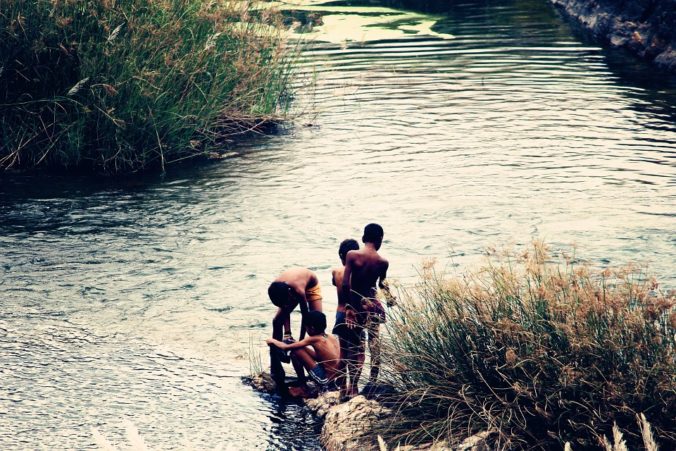
Goodness is like a stream running throughout the universe. Sometimes we’re swimming in it, and sometimes we’re not. But I’m not sure the Goodness River is something that you can toss your kids into; they have to learn to jump. As a parent, the best thing I can do is to dive in as often as I can, and assure them that they’ll float when I see them standing on the banks, contemplating a swim. And, as they come up from under the waters, greet them with a smile that shows them how proud you are that they’ve decided to take the plunge.

« Older posts Newer posts »

© 2026 Michele Minehart

Theme by Anders NorenUp ↑