Over the past several years, I’ve mapped the course of my life and the many ways in which I’ve changed as a person. Often, I see the biggest alterations of my inner self follows the movement of my physical self. When I moved, I changed. Each place in this world is unique, even when you move slightly down I-75. The people are different and, quite often, I am a different person as they greet me.
I began to look at my life through the lens of my geography. Noted: I am not a worldwide traveler. I’ve not made my home outside the borders of Ohio. Yet I find as I trace my path, that each move has changed me, notably for the better. This is not to say that people should move more – there is something to be said for roots. But the geography of my life tells my story.
Ancient cultures did a much better job of this. They would put markers – alters – in the places which were significant to them. Jacob woke from a dream and left a large rock to remember it. Peter, James & John walked with Jesus to the top of a mountain and wanted to build a little shanty so they could keep the vision a reality. I’m no geologist and I tend to sell my houses instead of keeping them for souvenirs, but I do have google maps.
 I was born and raised in Ridgeway, Ohio. Don’t look very hard on a map – you have to do some significant zooming. The population of my entire home county is pretty puny, until we claim students when Ohio Northern is in session and gain some weight. Small town (and I mean small – you people who live in Findlay and Troy, please take note of the McDonald’s within your city limits*) life suited me. It’s what I knew. I feel as if I should put on my resume the fact that I can list my graduating class in alphabetical order. (Jessica Adams, Alan Ashba, Diane Bettinger, Travis Cronley, Anthony Elsasser…**)

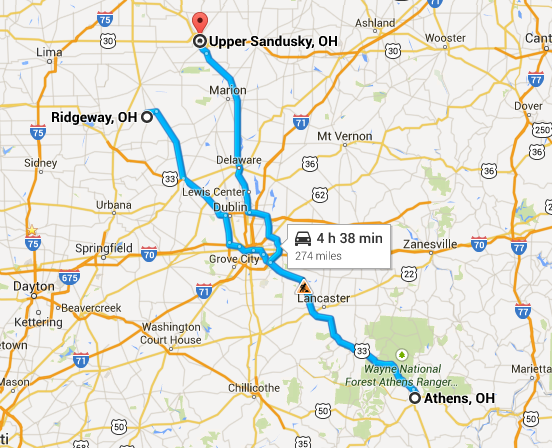
When I made numerous trips from Ridgway to Athens, it took at least 2.5 hours, if not 3. The 33 bypass is a big improvement. Also, not stopping at the 20 Minute McDonalds in Lancaster will shave some time off the trip.
My Ridgemont people launched me into life at Ohio University. Oh, those were beautiful days. The world got big. And small. I learned what friendship looked like (and I must say, ladies, you set the bar HIGH). I fell in love with Jesus. I fell in love with good beer. I fell in love with trees that changed color and green springtimes by the water’s edge. I found my legs in Athens. I had to walk (the hills!) everywhere, I began running for fun. I began walking on my own through life.
From Athens I headed to Upper Sandusky, answering an ad in the local paper for a need for a youth director. I’m not much into signs and God doing everything while you sit back and get a pedicure, but this really was an act of God. With a college degree and no prospective job, I had resorted to thinking I would have to be a secretary somewhere in Kenton for a short time until I got my act together. I’m pretty sure my parents feared the same thing. But then John Stewart (the church, not the comedian) posted their position.
 I fell in love in Upper Sandusky. First with a group of 13-18 year old students. And their parents. And KLR. And a few gray hairs in the UMW. And book club. And then with a particular 5’8 former kicker who worked at the funeral home. I learned about love when you lose someone as I grieved with a family and then with a church family. I found my heart in Upper Sandusky.
While living in Upper, I stuck my pinky toe in Ashland for seminary. Oh, that drive at 7am due east into the sunrise. Ashland was a delightful little town and one of my regrets is that I wasn’t present while not in class. Seminary was good to me, one of my best decisions. My God got a lot bigger there.
After God got so big and Love got so big, my little heart and head almost couldn’t handle it. I knew it was time to leave my position – mostly because I’ve never done anything for more than 4 years at a time; it’s what young people are trained to do – and JJ decided to make a change of career and we ended up accidentally-on-purpose buying a house in Findlay. He went to grad school and I got a big girl job.
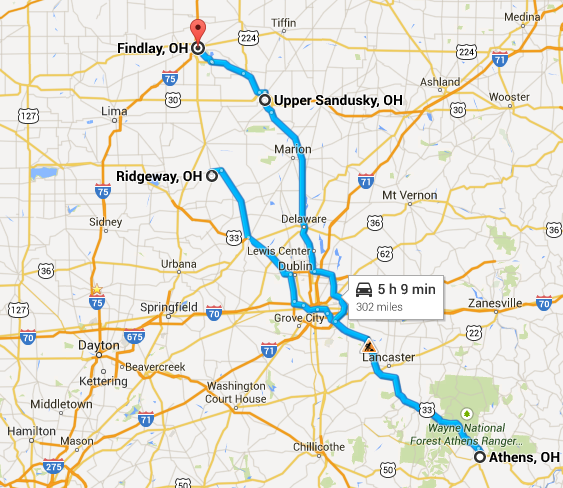 You know how at night, deep sleep is important to your brain, so that you soak in all the events of the day and the knowledge acquired gets attached to proper neurons and transmitters and you somehow grow? I found my brain in Findlay. I recovered from the day in Upper. I slept. (Well, not really, because that’s where we started a family.) I put all the learning and growing up in the right sections of the brain. If Upper Sandusky was shooting me out of a rocket into all the big Love and big God, then Findlay was where I drifted downward in a slow free fall. It was just like the movies, when people freefall in a skydive – slowly at first, delightful as you take in the scene, but as you near the earth the gravity gets stronger and there’s a crash as you hit the water.
That crash was August 1, 2011.
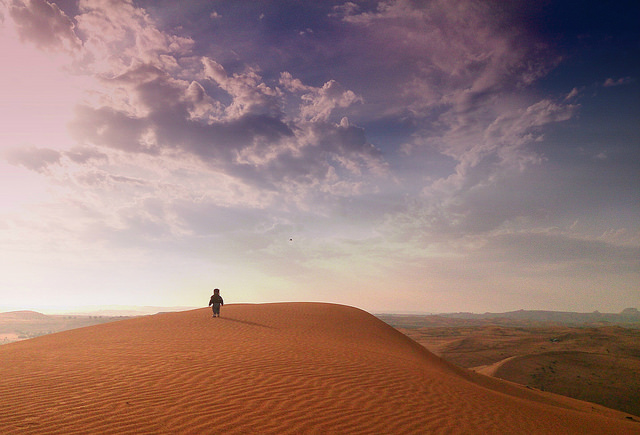
With a two-week-old baby and two toddlers, we were washed upon the shore of Troy, Ohio. I was immobilized. Again, like the movies, it was like arriving on a desert island. With 3 small children. And a husband who ran off to work every day to bring us food. That first year was hard. Nearly awful. I managed to find someone to watch my children so I could work part-time and that dear, precious woman down the street… well, she knew I had no one. She showed me a little more of God when I rattled on about nothingness at pick up and drop off. We went in search of a church home. Three times. I discovered that the primary ways people connect with their community is through work, school and church. I worked remotely, with children too young for school, without a church, so I was largely disconnected.
 Then we woke up one morning to a few small tribes of people who had stumbled upon our little family washed upon the shore. They made a fire and soup (from homemade broth and locally procured, organic vegetables) and fed us. They sat with us as we warmed and dried. They played with our children. We were invited into the tribes and learned new ways of living.
When Love got bigger and God got bigger and didn’t fit into my heart and head anymore, my people of Troy*** grew my heart and mind. I wasn’t such a strange bird here. I found space for all my big-ness.
In Troy, I have found my voice. My writing and thinking about ALL of the things has became more than mumbling. I have uncovered the things I love to invest in. I have discovered names for the thinks that I thought, like [Jesus]-feminism. I am matching my story, becoming avid proponent of small everything – business, farms, community. Even small people, like when Overfield reinforced my belief that toddlers are people, too. I live as if small changes matter.
Who knew along this path where I would discover my legs, heart, brain and voice? When I started the journey, I didn’t even know I missed them. It makes me wonder when and how I will stumble across the functionality of my hands, liver, and knees. What group of people, in what place will show me how to use those pieces?
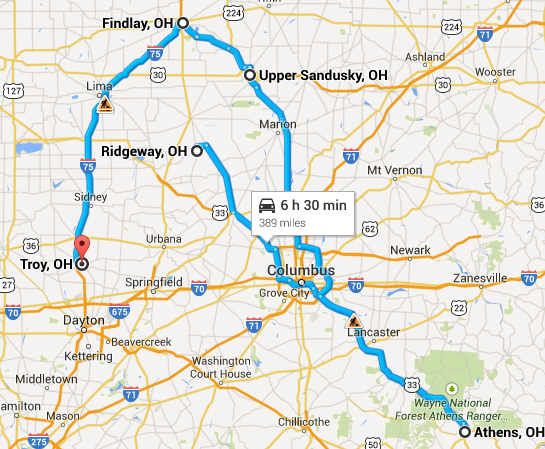
According to Google maps, my trip from Ridgeway to the present can be driven in 6 hours and 30 minutes, but it’s taken me 34.5 years to travel it. Perhaps I’m a tad slow. Or maybe I’m just stopping to admire the view along the way of life’s journey. In any case, to those who have walked beside me, thank you.
*Ha! “City” limits. Ridgeway is technically a village and I technically lived outside of it.
**My apologies for adding another listing on Google to whomever just searched these names. They are delightful people. Hire them.
***Trojans, yes?