Year: 2015 (Page 18 of 25)

What to do while waiting on a generation of fighting men to die

It’s story time, my friends! As usual, I’ll midrash-style this little tale, mostly for entertainment purposes so you’ll keep reading and wondering what is next. What does that mean? I may add a few words and phrases for dramatic flare, but the verses you read are the real ones. 

If you were raised with any sort of Christian background, you’re probably familiar with Moses leading the Israelites* out of Egypt toward a Promised Land. They crossed the Red Sea and saw the whales in the water while they walked on dry land. Then God showed up by fire at night and a “pillar” by day and just walked them through the desert. What a wonderful story!  But have you ever spent much time on the ending of the story? It doesn’t put the Israelite nation in such good light, so it doesn’t get told quite as often.

So they reach the edge of the Land which God has promised. The directions have been that God would go before the Israelites to drive out the people currently living in their land of milk and honey. Before actually doing what God says,  they decide to send out a team to find out what is on the other side. Moses says in Deuteronomy 1:23, “the idea seemed good to me; so I selected 12 of you, one man from each tribe.”

Now, if you jump over to the book of Joshua, you get the whole scouting report. Essentially 10 of the 12 taking notes come home with a blank page other than the words “we’re screwed.” The other two, one being Moses’ protege, said, “um, I think we ought to do what God said to do.” However, no one followed those two out of the pep rally – the fighting men sat down and refused to go. The fear of the Israelites is a whole other commentary.

To say that God was slightly pissy is an understatement. Lots of resentment on both sides begins to brew. Some He Said/She Said, a few slammed doors and God declared (Deut. 1:35) “No one from this evil generation shall see the good land I swore to give your ancestors…” (He goes on to exclude Caleb and Joshua, the 2 guys with a positive attitude after the scouting report.) Then he tells them to gather their things, they are all heading back toward the Red Sea.

Much like my own children, the Israelites suddenly muster up some willingness. “We’ll go! We’re sorry! We promise! We’ll do whatever you say!” They gather their weapons thinking they can just go and take the land like they should have the first time. God warns them not too, but they go anyway. Poor choice #642 of the day leads to more dead Israelites.

So they head out toward the Red Sea, wandering around the hill country. Finally God starts to give some direction (2:4-5): “You are about to pass through the territory of your relatives the descendants of Esau, who live in Seir. They will be afraid of you, but be very careful. Do not provoke them to war, for I will not give you any of their land… I have given Esau the hill country of Seir as his own.”

Then they come up to another section of countryside. God says, “Do not harass the Moabites or provoke them to war, for I will not give you any part of their land. I have given Ar to the descendants of Lot as a possession.” We learn that the Emites used to live there, hefty people that were driven from the land by the Moabites.

Just like the Horites, who used to live in Seir, but Esau’s clan drove them out. Then a funny little quote in 2:12 – “[the descendants of Esau] destroyed the Horites from before them and settled in their place, just as Israel did in the land the Lord gave them as their possession.”

Huh. How about that. But wait, there’s more!

So God then tells the Israelites to take their tour across the valley. By this point the entire generation of fighting men had died. They  go to a part of Moab at Ar. (Ar. I know. The creativity of town naming must be exhausting. I would  imagine this would be a land of pirates, except that they’re in the middle of the desert.)

God begins to sound like a broken record. “When you come to the Ammonites, do not harass them or provoke them to war, for I will not give you possession of any land belonging to the Ammonites. I have given it as a possession to the decedents of Lot**.” Come to find out, The Rephaites used to live there, but “the Lord destroyed them from before the Ammonites, who drove them out and settled in their place.” (2:21)

Three different lands on this little Hall of Fame tour. All three lands have people living in them, people who have not always been there. God promised each of these peoples a land and then gave it to them. Now, that sounds familiar.

(Also – and we can’t spend too much time on this – we can note that many of these are enemies of the Israelites. Huh. How about that. God will bless people whom we do not like and are not like. Noted, and time to move on.)

This ain’t God’s first rodeo. He has done this before. Whatever “this” is in our lives, God has been there, done that. He has references. Call his people, they will tell you he can be trusted, and He does what he says He will do. You can even call people not like you, people you don’t like, and they will tell you what you need to hear.

God clearly knows my and your propensity to try to capitalize on other people’s promises. Every time they walked through another museum of God’s work, he warned them, “don’t even think about trying to take this. It’s not yours. It’s theirs.” God shows us his resume not so we can have what others have, but so we will trust as others have trusted. Their promises are not your promises. Stop trying to make yours what God promised to someone else.

God gives another chance. It takes 40 years waiting for the Sad Sally army men to die, but eventually God takes them back. Then Moses sits down to pen another 32 chapters of instructions in Deuteronomy before giving them a green light. And dying. Which I suppose is probably why Deuteronomy is such a book – if you knew you were going to die at the end, wouldn’t you keep coming up with mundane instructions?

So here we go, my friends. If God has promised it, you can believe it. Ask around. Look around. The evidence is probably in the neighbor’s yard.


*Chrome tells me that the plural of Israelite does not exist. How can this be? I just did the worst thing and simply added it to the dictionary instead of looking up proper usage. Sorry-not-sorry.

**Yes, Lot has a lot of descendants.
No Greater Love

In the name of the Easter season I’ve been spending some time in John’s Gospel story. I have to be in the right mood for Johnny. He gets all sentimental with flowery love language, telling his version of the story in a bit of an unusual way, compared to the other 3 accounts (called in the academic world the “synoptic Gospels”).  I like the directness of Mark – he moves through the story as if it were a trip to the mall. “And then we, and then we, and then we...” And  Matthew’s rich history underwritten into his texts. And Luke the Equalizer and his love for the poor and downtrodden. So, John is more the Love Child of the gospel stories and thus when I need to get out of the business of religion, I turn to his words.

Specifically, I love his writings on Jesus’ pre-death soliloquy. Chapter by chapter, you can’t read it in one sitting – it’s much too rich. Chapters 14-17 are best in small bites. Today’s nibble that caught me was 15:13.

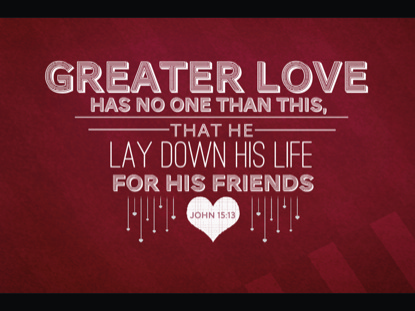
[box] “Greater love has no one than this, that one lay down his life for his friends.”[/box]

Now, I’ve always identified more as the one who received the love that cost life. Jesus died for me, so I’m receiving the Greatest Love. What a gift. Thank you Jesus, you shouldn’t have. I need to write a thank you note.

But today I dug out my 8th grade English skills and diagrammed this verse and realized I’ve been reading it all wrong. It’s hard in our murky English language with misplaced modifiers and gender-neutral language to completely understand it, but I’m fairly positive I’ve understood it backward.

While, yes, the beloved friends in the verse do reap benefit, they’re not experiencing the Greatest Love. That warm fuzzy is a mere bi-product. The Greatest Love goes to “the one” who is giving – giving the love, laying down the life. While we might feel special, we ought not feel as if we’ve achieved the Greatest of all Loves. We’ve simply been in relationship with one who has.

In our love-hungry culture, we frequently appeal to this desire to be loved. Look at our books and movies and find the undercurrent story of being pursued as the ultimate expression of love. I never watched it, but I believe 50 Shades appealed to a large audience because it played the strings of this desire to be the object of such a love. Christians, be careful – much of our language around dating, specifically for women, sings the same song. Be pursued. Wait patiently. It’s all very knight-in-shining-armor-y.

This narrative distorts the Greatest Love and leaves us hungry. When we devour romance novels and porn we taste something similar, but like saccharin, are not fulfilled. We’re dining on the wrong kind of love. We’re chasing a Receiving love. Jesus said we’ll be full when we begin to live a Giving Love.

Perhaps this is why God gave parenting as a gift and a practice. In this space, we’re thrust into Giving Love. We most certainly aren’t the Beloved of the relationship, and for many of us this might be the first time we’ve lost Beloved status. All of a sudden we’re Loving with costs, not just benefits.

Pair that with a culture that tells us that the measurement of our costly love is how our children turn out. Well-adjusted children become the measuring stick of love. No wonder all parents are neurotic. Because we’re seeing it backward. The beauty isn’t only in the Beloved. The real blessing is in the work of Giving Love.

The Easter season ought not be just a time to reflect on how much we are beloved, though we are and the day is a beautiful one to show gratitude. But it should be for us a time of year to focus on how we might be a Giver of love, someone who lays down one’s life.* If we stop at living the Beloved life, we’ll never actually experience the Greatest Love God has to offer.


*I appreciate and believe in the need for inclusive language. However, I also hate it and the way it can muck up a sentence.

My map of life

Over the past several years, I’ve mapped the course of my life and the many ways in which I’ve changed as a person. Often, I see the biggest alterations of my inner self  follows the movement of my physical self. When I moved, I changed. Each place in this world is unique, even when you move slightly down I-75. The people are different and, quite often, I am a different person as they greet me.

I began to look at my life through the lens of my geography. Noted: I am not a worldwide traveler. I’ve not made my home outside the borders of Ohio. Yet I find as I trace my path, that each move has changed me, notably for the better. This is not to say that people should move more – there is something to be said for roots. But the geography of my life tells my story.

Ancient cultures did a much better job of this. They would put markers – alters – in the places which were significant to them. Jacob woke from a dream and left a large rock to remember it. Peter, James & John walked with Jesus to the top of a mountain and wanted to build a little shanty so they could keep the vision a reality. I’m no geologist and I tend to sell my houses instead of keeping them for souvenirs, but I do have google maps.

ridgewayI was born and raised in Ridgeway, Ohio. Don’t look very hard on a map – you have to do some significant zooming. The population of my entire home county is pretty puny, until we claim students when Ohio Northern is in session and gain some weight. Small town (and I mean small – you people who live in Findlay and Troy, please take note of the McDonald’s within your city limits*) life suited me. It’s what I knew. I feel as if I should put on my resume the fact that I can list my graduating class in alphabetical order. (Jessica Adams, Alan Ashba, Diane Bettinger, Travis Cronley, Anthony Elsasser…**)

athens

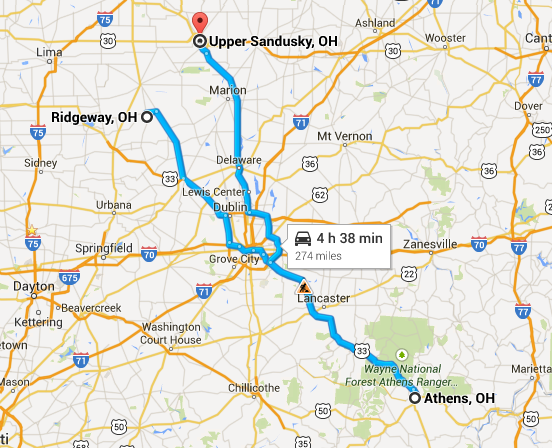
When I made numerous trips from Ridgway to Athens, it took at least 2.5 hours, if not 3. The 33 bypass is a big improvement. Also, not stopping at the 20 Minute McDonalds in Lancaster will shave some time off the trip.

My Ridgemont people launched me into life at Ohio University. Oh, those were beautiful days. The world got big. And small. I learned what friendship looked like (and I must say, ladies, you set the bar HIGH). I fell in love with Jesus. I fell in love with good beer. I fell in love with trees that changed color and green springtimes by the water’s edge. I found my legs in Athens. I had to walk (the hills!) everywhere, I began running for fun. I began walking on my own through life.

From Athens I headed to Upper Sandusky, answering an ad in the local paper for a need for a youth director. I’m not much into signs and God doing everything while you sit back and get a pedicure, but this really was an act of God. With a college degree and no prospective job, I had resorted to thinking I would have to be a secretary somewhere in Kenton for a short time until I got my act together. I’m pretty sure my parents feared the same thing. But then John Stewart (the church, not the comedian) posted their position.

upperI fell in love in Upper Sandusky. First with a group of 13-18 year old students. And their parents. And KLR. And a few gray hairs in the UMW. And book club. And then with a particular 5’8 former kicker who worked at the funeral home. I learned about love when you lose someone as I grieved with a family and then with a church family. I found my heart in Upper Sandusky.

While living in Upper, I stuck my pinky toe in Ashland for seminary. Oh, that drive at 7am due east into the sunrise. Ashland was a delightful little town and one of my regrets is that I wasn’t present while not in class. Seminary was good to me, one of my best decisions. My God got a lot bigger there.

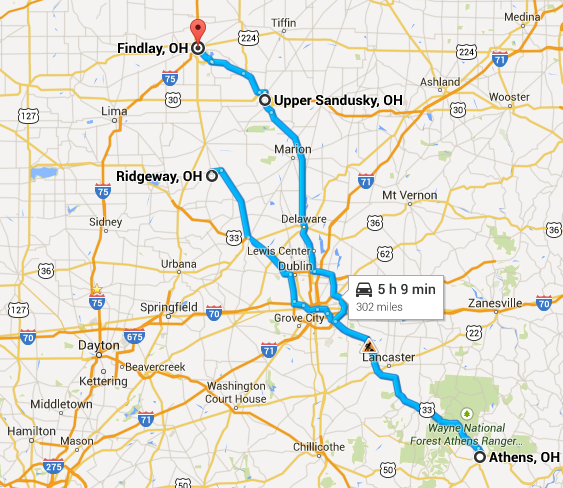
After God got so big and Love got so big, my little heart and head almost couldn’t handle it. I knew it was time to leave my position – mostly because I’ve never done anything for more than 4 years at a time; it’s what young people are trained to do –  and JJ decided to make a change of career and we ended up accidentally-on-purpose buying a house in Findlay. He went to grad school and I got a big girl job.

findlayYou know how at night, deep sleep is important to your brain, so that you soak in all the events of the day and the knowledge acquired gets attached to proper neurons and transmitters and you somehow grow? I found my brain in Findlay.  I recovered from the day in Upper. I slept. (Well, not really, because that’s where we started a family.) I put all the learning and growing up in the right sections of the brain. If Upper Sandusky was shooting me out of a rocket into all the big Love and big God, then Findlay was where I drifted downward in a slow free fall. It was just like the movies, when people freefall in a skydive – slowly at first, delightful as you take in the scene, but as you near the earth the gravity gets stronger and there’s a crash as you hit the water.

That crash was August 1, 2011.

With a two-week-old baby and two toddlers, we were washed upon the shore of Troy, Ohio. I was immobilized. Again, like the movies, it was like arriving on a desert island. With 3 small children. And a husband who ran off to work every day to bring us food. That first year was hard. Nearly awful. I managed to find someone to watch my children so I could work part-time and that dear, precious woman down the street… well, she knew I had no one. She showed me a little more of God when I rattled on about nothingness at pick up and drop off. We went in search of a church home. Three times. I discovered that the primary ways people connect with their community is through work, school and church. I worked remotely, with children too young for school, without a church, so I was largely disconnected.

troyThen we woke up one morning to a few small tribes of people who had stumbled upon our little family washed upon the shore. They made a fire and soup (from homemade broth and locally procured, organic vegetables) and fed us. They sat with us as we warmed and dried. They played with our children. We were invited into the tribes and learned new ways of living.

When Love got bigger and God got bigger and didn’t fit into my heart and head anymore, my people of Troy*** grew my heart and mind. I wasn’t such a strange bird here. I found space for all my big-ness.

In Troy, I have found my voice. My writing and thinking about ALL of the things has became more than mumbling. I have uncovered the things I love to invest in. I have discovered names for the thinks that I thought, like [Jesus]-feminism. I am matching my story, becoming avid proponent of small everything – business, farms, community. Even small people, like when Overfield reinforced my belief that toddlers are people, too. I live as if small changes matter.

Who knew along this path where I would discover my legs, heart, brain and voice? When I started the journey, I didn’t even know I missed them. It makes me wonder when and how I will stumble across the functionality of my hands, liver, and knees. What group of people, in what place will show me how to use those pieces?

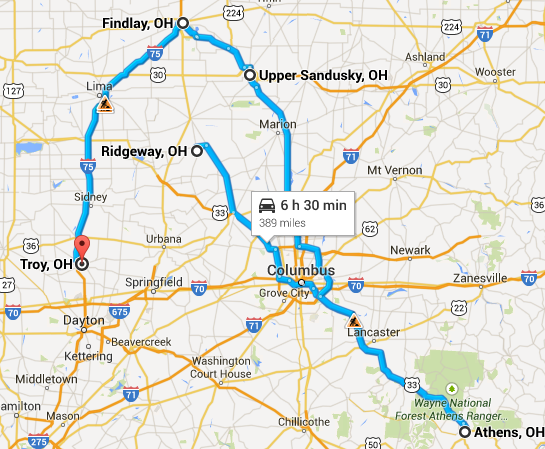
According to Google maps, my trip from Ridgeway to the present can be driven in 6 hours and 30 minutes, but it’s taken me 34.5 years to travel it. Perhaps I’m a tad slow. Or maybe I’m just stopping to admire the view along the way of life’s journey. In any case, to those who have walked beside me, thank you.


*Ha! “City” limits. Ridgeway is technically a village and I technically lived outside of it.

**My apologies for adding another listing on Google to whomever just searched these names. They are delightful people. Hire them.

***Trojans, yes?

« Older posts Newer posts »

© 2026 Michele Minehart

Theme by Anders Noren — Up ↑