Page 36 of 312

So, tell me about yourself

More than one friend has told me my blog tends to be a bit like Forrest Gump’s box of chocolates in that you never know what you’re going to get. And I love it that way. True to my generation, I hate being boxed in. But, part of me often wonders… what do others think? How does this help? Where do I miss the mark?

It’s funny, some of the pieces I write that are dearest and in which I’m most excited to hit “publish” are the ones that barely make a blip in response. And then others, it’s like I struck a nerve, and I had no idea I was sitting close to it.

So, give me all you got. It’s like 6 questions and a free space. It’s all anonymous, I’ll have no idea who says what. (But please, be kind. Remember, I’m a words of affirmation person.)

You can click below and not leave the page, or use this old fashioned link to survey monkey.

Create your own user feedback survey

Empty Branches

Last weekend, because I’m not proficient with ceiling fan instillation, I was relegated to working in the flower beds. The Lamb’s Ear and the hostas waved dry and empty stalks. The decorative grass was seedy and eating our front porch. A few other things, no longer recognizable, were completely dried up. The place was a mess of dead leaves.

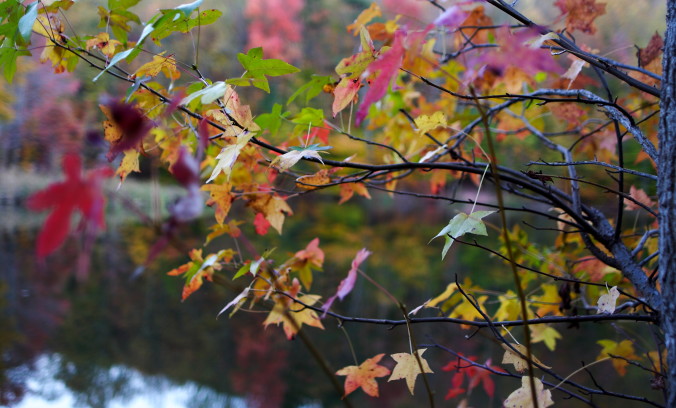
In the hour I spent hacking and chopping and trimming and scooping, I gave a lot of thought to the the autumnal processes. Plants, after living the glory of full bloom, offer new seeds to disperse into the world and then, generally, spend the next several weeks in hospice. The classy ones, like the oak trees and burning bushes, use brilliant hues to say their goodbyes while others simply shrivel up and the next thing you know, you have empty branches.

Nature pretty much self-directs this process. Trees aren’t shocked when they end up naked; in fact, so goes the cycle of life. In order to have new life, we must rid the old growth. The simple truth remains: nothing new will grow where the old hangs on past its season.

This past week I participated with my yogis in what we call an “Ayurvedic Reset.” There are several components, most notably the mono-diet of kitchari. I ate it for lunch and dinner all week; kitchari is considered the “child’s pose of food”, a gentle place to find your breath again.

Quite honestly, I enjoy kitchari… about once a week or so. The last batch I made ended up tasting quite awful to me. Part of me wanted to join in for the fish tacos and call my near-week’s abstinence “close enough.” So many other things sound more delicious. Like tacos. Or, by the end of a reset week, maybe even leather shoes. Or chalk dust. Honestly, I love food so much that restricting me to one type is nothing short of torture.

So why participate in such practices? Life is short, eat the brownie used to be the motto of my college years. Which is true. I’ve decided never to turn down a plate of my grandmother’s noodles for similar reasons.

If you get into certain spiritual circles, fasting often comes up. You can’t swing a cat without hearing “every time I get hungry I just pray.” And that is nice. Well done. I’m glad people find that element of the fasting practice helpful. I do not.

But here’s what I’ve learned: by limiting my diet, I practice how not to limit my joy. 

Food brings me joy! It’s a love language. I believe Shauna Neiquist will back me up on this. And, as you would have it, Rob Bell. He spoke to me personally on this. Well, through his Robcast, recorded weeks prior… but I heard it while in the want-to-quit middle of my reset and it resonated deeply. He said we tend to mis-believe our joy is limited to only the food, drink, habit or sensation we’re craving.

And I thought back to my flower beds. Each branch sprouts only one leaf at a time.

A healthy tree will bloom over and over, enjoying new seasons with something different on its fingertips. What if the same is true for our souls? We can practice enjoying something, and then set it aside so to allow room for something else just as joy-worthy to sit down for a spell.

So perhaps we take a cue from the trees and realize we need to let a few things go? Just for a time, a season, a purpose – let them fall. Because when we do, we will likely find something new is able to grow.

I want new things to grow in my life, but I don’t get to have that without a regular cycle of letting things go. “Clearing space” is a mantra I keep close.  This can mean getting rid of stuff that was once vibrant. But nothing blooms year-around (at least not in these parts) without manufactured conditions; hibernation is key for a plant to offer something again in the spring.

And so it goes for our souls. It’s time to let go of the things which have passed their season. Perhaps not forever, but for now. If you want something new to grow in the future, it might be time to put things into right places. And maybe, right now isn’t the time for new growth. Right now is the time to get settled in for the long winter’s peace. Some things, including you, are allowed to go dormant for a season.

As the trees show us, letting go can be quite beautiful.
God, the Terrible Farmer

I grew up in Farm Country with a Farm Family. I was potty trained behind tractor tires and spent Easter Sundays with shredded chicken sandwiches in the back of a pickup truck. I climbed in empty orange wagons for fun. Our family retired the Internationals when I was 16, but I have some familiarity around farmground.

Which gives me the authority to tell you: Jesus was a terrible farmer.

In two editions of his life story, we hear him tell about this farmer, representative of God, who sowed seed. Some fell on the road (and the evil snatched it up, we hear later), some in the thorny patch (choked by the cares of the world), some in the rocks (which withered when the sun came out) and then some in the “good soil” which reaped a healthy crop.

Anyone with a Life Application Bible immediately jumps to “how to become good soil” so the Word of God takes root and is fruitful. Well done.

Except.

If my dad’s good friends, all farmers, were to follow around this God Farmer, they would do so with satchels over their shoulders and dustpans in their hands to pick up all the seed God is wasting. I can hear the expletives escaping from Don’s mouth already, how only an idiot tosses perfectly good seed every which way.

God would make a terrible farmer. He doesn’t even know where to plant the seed. It goes in the field, God. Where it has a chance to grow

Jesus offers us this parable for reasons that extend beyond an encouragement to “be better soil.” This is paradigm-shifting stuff. He’s moving us from commands – not to plant more than one kind of crop in the same field – to tossing around the seed all willy-nilly.

I see your eyes shifting slightly to the left, the way that they do when you wonder where I’m going with such an idea.

Because everyone was quite confused (Wingfield Farms wasn’t the first to figure out seed grows best in fertile soil), Jesus tells those closest to him “the seed is the Word of God.”

Fast forward to all the other little tales Jesus tells. Something about a treasure chest  in the middle of a field and a pearl at a flea market… that’s funny. God’s treasures seem to be sown about in the most unlikely and unexpected of places. Nay, dare I say it, in the most unlikely and unexpected of people. Maybe the most unexpected experiences, moments and relationships.

In this life we have a few options. We can believe that corn goes in corn fields and beans go in bean fields, forever and ever amen. And we’ll find what we expect. We also might get a tad upset when a random weed creeps in, disrupting our work of perfection.

I believe Jesus invites us to a life of discovering God everywhere. The places you would least expect. In the Bible it was in a bush, in the belly of a whale, under the clear blue sky, and under an unpredictable plant. In the hick-town of Nazareth.

If God shows up there, who is to say he won’t show up in the football locker room? During the spelling bee. At the board meeting. In the simple act of teaching a child to tie her shoes. In baking for a family who grieves. You could say “God is in the small things.” Or, perhaps more accurately, there are no small things. There are no insignificant things. There are no insignificant people, places or moments in life.

God sows his seed all over this creation. His gift is the process of discovering it.

I’ve mentioned Sarah Bessey before, and my passionate love affair with her book Out of Sorts. I feel like we’re kindred spirits when it comes to this issue; she writes that God is in the work of our every day, normal lives. Of course, God is in the church work, the groups and studies, as we might expect. Church can be a bean field, filled with beans. Good soil. But please, dear friend, don’t limit God to that. Don’t put up a fence row and go on believing you’ve done sorted out all the details. Please don’t believe you’ve found all of God under that little steeple.

Our God is much bigger than where things are supposed to go and supposed to happen. He’s throwing Himself into everything. Perhaps it doesn’t always take root. Perhaps evil will steal a bit away. But He keeps throwing his seed around. He throws it around like he will never run out.

I want to live my life like that. With that kind of generosity; that kind of hope. May we live like God has planted Himself anywhere.

« Older posts Newer posts »

© 2026 Michele Minehart

Theme by Anders NorenUp ↑