Category: Uncategorized (Page 6 of 188)

Promises, promises

My educational background provided me with a public relations mind, so I get it. I know the “felt need” element of selling anything. I realize that often in this world we simply need to give people a reason before they care, specifically before they care enough to take action.

Seeing how this is my training and often a part of my job(s), I regularly hate myself.

The problem with felt-need based promotion is professionals actively work to make you feel like you’re not enough. The entire process is creating a ____-sized hole, which you come to believe can only be filled by what the promotion offers. In order to be enough, you need a faster car, a bigger home, more shiplap, less bodyfat, more probiotics, less plastics, and perfect children.

(My least favorite explanation that advertisers give for you making these purchases: “You deserve it.” While I do think you’re indeed a fantastic person, why do we cling so tightly to this earning-based mentality? But that’s another post.)

An article shared by my teacher’s teacher (My grand-teacher? My upline? I lack the vocabulary here.)  added to this notion, specifically in how this is experienced in the fitness and health industry:

I don’t care about elite performance, but I do care tremendously about living long enough to know my grandchildren. I care deeply about having a solid quality of life and aging gracefully. I want my later years of life to be filled with beautiful memories of close friends and family and not full of doctor visits, endless bottles of pills, and long hospital stays. I want to take long walks on the beach when I’m 80, holding hands with my husband without being afraid of falling down. I want a tribe who cares about that. (-Michael Keeler)

I won’t say we’re all perfect just the way we are. It’s a both/and situation. We are enough, and we have work to do. We’re not finished. And the needs we feel? They’re real. Our humanness means we feel, we think, we grow. It is the nature of the universe to expand, and thus we won’t reach some state of doneness.

You see, many people (myself as one) are not interested in all the shortcuts to meet our actual needs. Six-pack abs are a superficial means of striving for acceptance and worth. Marketers want you to believe that a gorgeous midsection yields likability, but truth be told, I know plenty of people who have a rockin’ bod and are still assholes.

These real needs cannot be solved by a purchase for $49.95. It takes more than the right exercise or pair of pants – it takes time, energy, and a personal investment. These needs are only met with change; a change that happens below the surface of appearance.

I believe the heart of the author’s letter to the fitness industry was saying, I want change. I’m ready to do the work. Please help me. Until any of us get to that point, we’ll just be thinner (and probably poorer) versions of our same self, with the same needs lingering below the surface.

So here’s my disclaimer. Perhaps I’ll include it as fine print on all my “promotional” materials (because, ultimately, somehow, I have to tell you the options I’m offering to help you along the way): my yoga classes, my written ideas and thoughts – they will not change your life. Only you can do that. 

It comes from within, my friends. It’s a well that doesn’t run dry, but only you can do the digging. I’m trying to be the kind of person who can hand you a shovel and bring you a beer, because that’s what I’m looking for as I do my own digging.

Carry on, my friends.
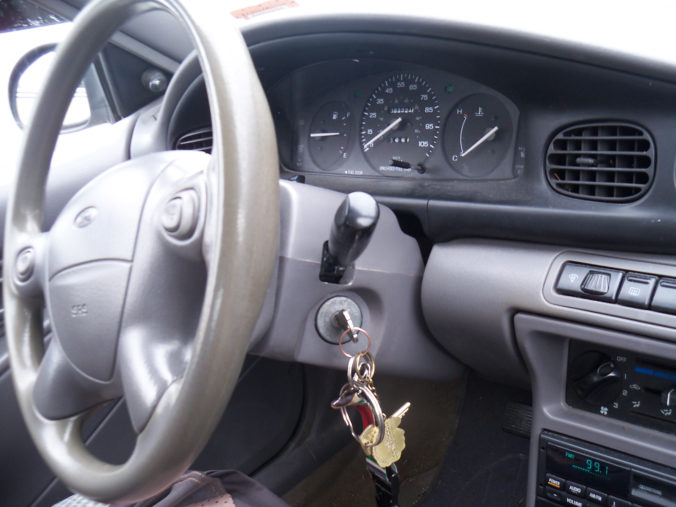
Locked into habits

I locked my keys in my van last week. For the second time. When I drove my trusty Odyssey, I cannot recall a single time that I had the keys on the wrong side of the locked door, but in just a few months I’ve managed to be dependent on AAA and a nearby friend to get back in the driver’s seat.

The function of my Toyota is no different than my Odyssey; both have “clickers.” (This is how all people refer to the keyless entry, right? “Clicker?” Related: my family never looked for the “remote control” but rather we had a “flipper” that, you know, flipped through the channels. I have a dialect unique to my upbringing.)

On both occasions of zealous locking, after I arrived at my destination, I put my keys in my purse. My keys have a home in a little side pocket. My habit is to put them into their pocket, put my purse on my shoulder and hit the lock on the door on the way out. I’m too impatient to wait on the sliding doors to shut before using the clicker to lock up.

On the days in question, after mindlessly putting my keys in my purse, I decided I didn’t need the huge bag and only grabbed my wallet. As my door shut, I literally said out loud (on the phone, which is another factor in the equation): I just locked my keys in my car. I knew it before I was 5 steps away.

I’m fascinated by the way our habits serve us. I’m a creature of habit: I love rhythm and order. I complete many of the same tasks, in the same way, each day. I can be in and out of the shower in 5 minutes because I have an order (wet hair, shampoo, soap up, rinse shampoo, condition, shave, rinse conditioner) and it requires zero thought. I can easily pull together a dinner from my top 5 meals (vegetable soup, kitchari, fried rice, chicken soak, sloppy joes)  without giving it focus because my habits serve me well.

Yet there are ways – spaces in our lives – in which our habits don’t serve us. Such as the way in which I’m unable to pull dates from my memory bank because I’m completely dependent on my visual (paper!) calendar. I have taught myself to give zero brain space to times, days or dates because once it’s written down, it’s dismissed from my brain. If you ask, “hey what are you doing next Tuesday? Want to go to London with me to see Adele for free?” I would STILL have to look at my calendar to see if the youngest goes to preschool that day.

So much of the ways we live our lives come down to the smallest tendencies to which we give little thought. The order you run errands, the process of putting kids to bed, how we open a car door and slide into the seat (ask your chiropractor if that one has consequence!).

Sometimes, habits fail us. Our mindless dependency, while advantageous in the broad sweep, kicks us when we’re not paying attention.

How often do we call into question our habits? Not just the way in which we complete tasks, but our patterns of thinking and believing as well? Do we really believe a particular idea, or have we created a habit of thought and operate from that framework? Is that way of thinking still serving us and helping us grow?

What if our habitual thoughts are actually hindering relationships, opportunities for meaningful work, or new experiences? If my starting belief is that anything fun costs too much money (because, for a family of 6, it seems everything costs too much money), then I will continue to shut down on requests to try new activities – and in the meantime, completely miss out on the joy of discovering a new park or finding a trail. The knowledge that things are often expensive for large families will serve me, but depending on that habit to make our decisions will cut us off from experiences of delight.

So in my next moment of frustration, conflict or disappointment, I wonder how it would look to ask what habit am I depending upon right now? What is the underlying pattern of behavior or thought? And if I prefer a different outcome – say, perhaps, to stop locking my keys in the car – what new habit might be formed that could better serve my situation?

God, CEO?

Many of our deepest theological inquiries revolve around the nature of God and God’s decision-making process. Why this and not that? Why me and not him? Why now and not then? Events of our lives transpire and we lack insight into the larger picture of what’s going on. Nice Christians remind us that “God’s plan” is bigger than our own lives (true), yet we’re often unsatisfied with the idea that terrible things can happen to good people, simply because God Said So.

These types of frustrations, of which I have experienced more than once, I believe come from an understanding of God as Other. God, the Boss Man. The CEO who has to make decisions for the sake of the company, and the individual employees may or may not like it.

When I was at a big(ger) workplace, we had a fantastic boss who everyone loved to love. He took us to Vegas our first year – paid for the tickets and the rooms and a smokin’ party. And then when the market fell apart, he had to make hard decisions. There were lean years.Benefits were taken away, hours were cut.  We still wanted to believe in this boss because we knew, at the core, he was a good boss and we worked for a good company. But life kinda sucked for a while and we were left to decide, “will my bossman take care of me in the end?” By the time I left, most of us were working hard for good reviews in anticipation of a decent year-end bonus, which is my understanding of most large workplace environments.

God as a CEO is a helpful way of understanding God Over Us. God as the One in control. This understanding is heavy throughout our scripture because God as King threads the narrative. Hierarchy was the structure of society – and often still is – and if our way of understanding God doesn’t fit unto our understanding of the world, it’s often not a helpful theology.

This line of thinking has largely dominated much of what I’ve experienced in religious life. Make the Boss happy and earn a great retirement.

I would like to propose: God is not only Over Us. God is also In Us and Through Us. God works outside the corner office.

I now work at a very small practice, working in multiple roles. Two individuals are the business “owners” and at times they have to make strategic decisions about the next steps. Yet no one in the office is working toward an annual review. There is not a boss-man to make happy as much as an ethos that permeates the practice. We all do our work, as varied as it might be, infused with the same intention. As the newer person, I’m often listening closely to their language and watching their actions, because that’s how I begin to fall into the rhythm.

Each phone call, lunch meeting and appointment carries the essence of the organization, not because the CEO printed it on a shirt, but because it taps into something that’s already within each of the individuals working here. Our workplace is a lot of “Yes! Do more of that!” with a “Have you tried…?” offered when needed.

Imagine God is also like that. God is not only Over Us, but God is With Us; Immanuel, the essence of this season.

« Older posts Newer posts »

© 2026 Michele Minehart

Theme by Anders NorenUp ↑