Category: God (Page 6 of 14)

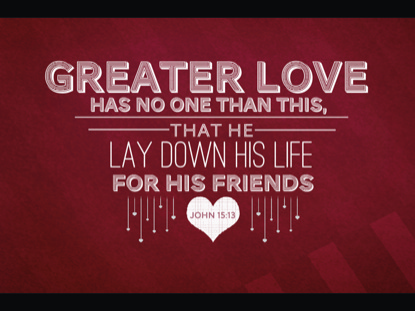
No Greater Love

In the name of the Easter season I’ve been spending some time in John’s Gospel story. I have to be in the right mood for Johnny. He gets all sentimental with flowery love language, telling his version of the story in a bit of an unusual way, compared to the other 3 accounts (called in the academic world the “synoptic Gospels”).  I like the directness of Mark – he moves through the story as if it were a trip to the mall. “And then we, and then we, and then we...” And  Matthew’s rich history underwritten into his texts. And Luke the Equalizer and his love for the poor and downtrodden. So, John is more the Love Child of the gospel stories and thus when I need to get out of the business of religion, I turn to his words.

Specifically, I love his writings on Jesus’ pre-death soliloquy. Chapter by chapter, you can’t read it in one sitting – it’s much too rich. Chapters 14-17 are best in small bites. Today’s nibble that caught me was 15:13.

[box] “Greater love has no one than this, that one lay down his life for his friends.”[/box]

Now, I’ve always identified more as the one who received the love that cost life. Jesus died for me, so I’m receiving the Greatest Love. What a gift. Thank you Jesus, you shouldn’t have. I need to write a thank you note.

But today I dug out my 8th grade English skills and diagrammed this verse and realized I’ve been reading it all wrong. It’s hard in our murky English language with misplaced modifiers and gender-neutral language to completely understand it, but I’m fairly positive I’ve understood it backward.

While, yes, the beloved friends in the verse do reap benefit, they’re not experiencing the Greatest Love. That warm fuzzy is a mere bi-product. The Greatest Love goes to “the one” who is giving – giving the love, laying down the life. While we might feel special, we ought not feel as if we’ve achieved the Greatest of all Loves. We’ve simply been in relationship with one who has.

In our love-hungry culture, we frequently appeal to this desire to be loved. Look at our books and movies and find the undercurrent story of being pursued as the ultimate expression of love. I never watched it, but I believe 50 Shades appealed to a large audience because it played the strings of this desire to be the object of such a love. Christians, be careful – much of our language around dating, specifically for women, sings the same song. Be pursued. Wait patiently. It’s all very knight-in-shining-armor-y.

This narrative distorts the Greatest Love and leaves us hungry. When we devour romance novels and porn we taste something similar, but like saccharin, are not fulfilled. We’re dining on the wrong kind of love. We’re chasing a Receiving love. Jesus said we’ll be full when we begin to live a Giving Love.

Perhaps this is why God gave parenting as a gift and a practice. In this space, we’re thrust into Giving Love. We most certainly aren’t the Beloved of the relationship, and for many of us this might be the first time we’ve lost Beloved status. All of a sudden we’re Loving with costs, not just benefits.

Pair that with a culture that tells us that the measurement of our costly love is how our children turn out. Well-adjusted children become the measuring stick of love. No wonder all parents are neurotic. Because we’re seeing it backward. The beauty isn’t only in the Beloved. The real blessing is in the work of Giving Love.

The Easter season ought not be just a time to reflect on how much we are beloved, though we are and the day is a beautiful one to show gratitude. But it should be for us a time of year to focus on how we might be a Giver of love, someone who lays down one’s life.* If we stop at living the Beloved life, we’ll never actually experience the Greatest Love God has to offer.


*I appreciate and believe in the need for inclusive language. However, I also hate it and the way it can muck up a sentence.

Where the joy hides

When graduating from college, at a major crossroads in my life, I remarked to a friend that I was sure God was teaching me patience. I wish he would just let me catch all red lights and let it be a lesson, I said, as opposed to using my actual life to grow the quality.

Since then, when someone says “I need more patience” I see it as an invitation for God to come in and make things messy. There’s no such thing as a patience delivery system, unless you include children. Want more patience? Have another baby, that’s what I say. Not because it’s some beautiful sudden blossoming of patience. It’s more like each child grabs a limb and starts pulling in a different direction, ripping and tearing until a single drop of patience dribbles out. And, much like most forms of body hair removal, such processes are both painful and repetitive.

I should not have been surprised, then, when at the end of a recent yoga practice God called me out for the day’s intention to “find joy.” He said it was back assword, or some holy way of putting it.

The notion of finding joy, much like needing patience, starts with the wrong premise. Now on this side, just hearing “finding joy” conjures images of me sitting at a table of white linens, waiting to be served, as if seeking out the world’s best Pad Sea Ew. Such endeavors include elements of comparison (which we all know now as the “thief of joy”), analyzation and competition. I see Brene Brown’s scarcity mentality all over that one, as if there’s only one “real” version and the rest are only best attempts.

Yet this is the language given to us, yes? We must “find joy in the small things.” You know where that puts joy? In things. In people, namely others. It makes joy the object to crave and hunt. And when you don’t find it? It’s either so elusive you can’t see it or you’re left feeling as if perhaps you’re unworthy of such gifts.

Armed with my perspective of patience (and similar theories on love, peace, kindness and the like), my moment with God on the yoga mat revealed that I’m looking in the wrong places for joy, which is why I don’t find it. Much like Dorothy and her shoes, I’ve been wearing it all along. Joy, a fruit of the Spirit, is something that is grown in us. It’s the evidence of God’s presence in our life and it appears, as Eugene Peterson says, “as fruit in the orchard.” It grows. It’s planted within.

My teacher likes to use the word “cultivate”. The farmer’s daughter in me likes that idea. I imagine pulling a plow (amish-style, not these fancy ones farmers have nowadays that drive themselves), planting seeds and a nurturing the environment of sunshine and water. It’s something that grows, but requires my part to make the conditions right for it to live and bloom.

If I’m not “feeling joy” it’s not because my children or my husband or my job or my life aren’t worthy joy-bearers. It’s because I’m too busy producing a life of Effectiveness and Efficiency and Excellence. (Obviously, the problem is my propensity with big words that start with the letter E and my love for alliteration.) Not that these traits aren’t noble or helpful or admirable. There’s a place for them. The Big Words are evidence that I am striving for something great, but not evidence that God is working in my life.

Saturday morning on the mat, I had a day ahead of not much planned. I thought it would be the perfect occasion to practice looking for the simple joys rather than enduring the regular frustrations. And while a noble idea, it started in the wrong place, with joy hiding from me and I, on a quest to find it “out there.”

No, if the joy was hiding, it was under the unnecessary gunk in my soul. The competition, the comparison, the condemnation for not doing it right/well/enough. (Alliteration, I said sit down!)  Joy is in me – because God put it there, because God lives there – but I’m not always living from that place of joyfulness. I’m often leading with the wrong foot – with the self rather than the Spirit.

So here we go. Joy not “in the small things” but perhaps lived out in the small ways, in this little vehicle named Michele.

Changing the world while wearing a baby sling

I’ll confess, I have a secret love affair with the most boring books of the Bible. People make jokes about falling asleep reading Leviticus, but I find it a fascinating revelation of the course of life when it was written. Find it no surprise, then, that my current reading is Deuteronomy. (Also, I got a new First-Century Study Bible for Christmas – “Explore Scripture in its Jewish and Early Christian Context” – which probably only furthers my complete geekery, but gives me joy nonetheless.)

The book of Deuteronomy is like a “final thoughts from Moses” letter – do not fear, don’t forget to turn of the coffee pot, do not fear, remember all the stuff God did for you, do not fear… you get the drift. He starts at the finish line – they’re standing on the edge of the desert, in the foothills of the land promised to them decades ago. And he tells the story about what happened when God said, “go!”

Now, I don’t believe this story, or any Biblical account, gives someone wearing a Christian badge the right or authority to start overthrowing cities and homes. These specific people were promised a specific place. They were following a cloud of God to get there. While I love a good analogy, we must be careful to know the limits of our rhetoric. I’m guessing that God did not specifically call you to go and take the really nice house in a neighboring subdivision. I’m just sayin.

So, back to the edge of the desert. God says, go! Actually, He says things like “do not be afraid, I will go with you and I will fight for you,” and encouraging things that you should cross-stitch into your pillow. However, as we know, such sayings sound good but often do little to cut the fear. So the people of Israel pretty much say, “What the hell, God? You brought us all the way over here to die?” You see, they had sent a scouting team and they came back with a 10/12 report that the people were giants and the Israelites had no hope.

To say God was a little angry would be an understatement. He “solemnly swore” (1:34),  which we all knows only happens just before an epic topple, that no one from the generation would ever see the good land. They were all heading back to the desert until a new group of Israelites – ones who would listen – grew to follow through on God’s instructions.

[box] “And the little ones that you said would be taken captive, your children who do not yet know good from bad – they will enter the land. I will give it to them and they will take possession of it. But as for you, turn around and set out toward the desert along the route to the Red Sea.” (Deut. 1:39-40)[/box]

This stopped me in my tracks. I know the argument because I argue it all the time. But what about the children?! I can’t just go off and DO all this stuff because I have little ones entrusted to me. Someone could hurt them. I have to think about their future. I want to offer them the best, and danger is not the best.

Image via CC by ‘‘ ِ Abdallah Al-Qahtani

Image via CC by ‘‘ ِ Abdallah Al-Qahtani

I’m a firm believer that the Bible doesn’t have random, meaningless writings in it. God answered these people with reference to the children they feared loosing because it was probably one of their grumblings against doing what God said to do. It was a scary command, one they weren’t convinced they could actually succeed, and to top it off, mama had an infant on her back and a toddler on her leg.

God gives a different version of good parenting than my natural inclinations. He says that we are to be faithful to him first. When we’re not faithful to follow God’s instructions, instead of protecting our children we are handing them our battles. In our desire to give them the good and right thing, we must, in faith, step out and do the hard thing. We must answer God’s call.

When this particular generation of Israelite parents declined God’s command, they also forfeited giving their children the opportunity to grow up in a land flowing with milk and honey. Because they were afraid to fight for it. Instead, they took these babes back to the desert to wander around. Their children buried their parents under sand and rock in the middle of nowhere. And these parents left their children without a legacy of faithfulness. Instead of telling their children, “we believed God, so we did it and now we live a blessed life,” they had to rewrite the narrative to say, “we didn’t believe God – please don’t make the same mistake. All eyes are on you, my child, to take these people into the place God promised because I didn’t.

Many of us want to raise children that love God and others. We want good, Christian kids who will turn into faithful, loving adults. That’s fantastic. But what will get us there is probably not charts and prizes for memorization of the Bible (though, that’s a nice thing to have scripture hidden in our hearts) but rather a front-row seat to watching parents believe God and live faithfully. The studies out there are clear: the number one influencer on a young person’s faith isn’t a stellar youth group. It’s parents who value their faith and live like it.

I’m not talking about curbing language because it’s “not Christian” or making a show of reading the Bible. I’m talking about the way in which you respond to God’s call on your life. When you take that thing, that I-have-to-do-this thing and turn it into something for the glory of God, and your children have a front row seat to watching it unfold, that leaves an impression. When mama has to leave for a small group or a meeting or an event and comes home glowing in a way that only means she experienced God – that sticks far more than mama staying home and saying that it’s important to be like Jesus.

If we don’t do the work God has set in front of us, the scary thing to which we are called, that which needs God’s presence or a complete failure is sure, than we will hand off that battle to our children. That’s not keeping them safe. That’s not giving them a good life. That’s handing down the wrong legacy.

God asks us to stop hiding behind our children, using them as a basis for our fears. Instead, we are to step into a faithful life that will give them an example of what it means to follow God.


**Obvious but I’ll state it anyway: Don’t do stuff that puts your kids in direct line of danger and just “hope for the best”, please. This is about how we use parenting as a shield for our fears. God isn’t into child sacrifice – just read the book. 

« Older posts Newer posts »

© 2026 Michele Minehart

Theme by Anders NorenUp ↑