Category: God (Page 10 of 14)

Bring along a God Box

[box] “… and Israel was badly beaten – about 4,000 soldiers left dead on the field. When the troops returned to camp, Israel’s elders said, “Why has God given us such a beating today by the Philistines? Let’s go to Shiloh and get the Chest of God’s Covenant. It will accompany us and save us from the grip of our enemies.” (1 Samuel 4:3) [/box]

After a particularly bad battle, the Israelites went home defeated and confused – why did God let them lose? Someone had the great idea, then, to make sure God would be on their side. They fetched the Chest of God’s Covenant (the “ark” for you traditional scripture-readers) and brought it with them to their war camp. When the chapel team arrived with the visible image of God’s presence in tow, the troops erupted in excitement. If God is for us, who can be against us, right?

The Philistines heard the ruckus and freaked out. They had heard about this God, the one that sent plagues upon Pharaoh and all of Egypt, the one that marched his people out of slavery. Someone probably gave a rousing speech in the locker room warning the soldiers to fight for their lives.

And they did. The Philistines obliterated the Israelites. The first battle left 4,000 dead on the field. The one where the God Box sat under a nearby tent saw 30,000 bodies at the end of the battle.

Why would God let his people be defeated? Don’t we read stories of victory in the Bible, especially when God is involved?

If we look later in these books, leaders like King David would often invoke the name of God into battle. Read on the books about the Kings and see David time and again asking, “God, if I go to battle, will you be with me?” and getting a response from God – yes. God’s presence will go before. This is the confidence preached in churches everywhere (because it’s true).

The Israelites never asked God. They never sought his wisdom, they never considered his will.

In 1 Samuel 4, the Israelites assume that they make God give them what they want. I suppose this is the difference between a living God and a box made of wood. You can march around with something that represents God’s presence, but that doesn’t guarantee God is in it.

How often do we mistake one for the other? We decide to go to battle and assume that if we bring the right scripture along or the dress up our intentions with the right theological words and ideas, then surely God will be for us.

We don’t get to drag God around like a puppy. We chase Him. We look to what He is doing in the world and we jump in. We’re God’s followers, not God’s leaders.

Discerning God’s will can be tricky stuff and passages like this add a layer of complexity. Yet they offer us safeguards from deciding that because we can put a Jesus Label on it, surely it is good and right. No, those passages that declare God will give us our desires and needs are prefaced with phrases like “seek ye first the Kingdom of God.” God guarantees he will not send us anywhere without His presence. Which is different from convincing God to come along to the next place you want to go.
Dead Leaves & Hidden Fruit

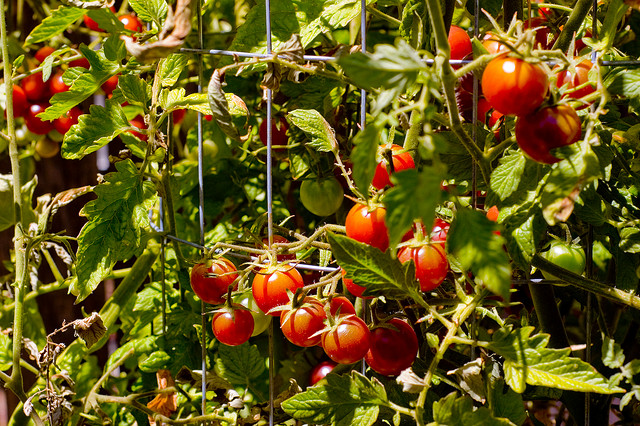
JJ has been less than impressed with my contribution to the family garden this summer. I blame it on our constant comings and goings, but the fact remains I nary picked up a hose this summer nor reached into the dirt to pull a weed or 5. Now, as the tomato harvest overwhelms us, I’m left to pay up.

tomato plant

Image credit: CC Benjamin Chun

The first time I went into our patch of plants, I realized part of the problem lied in our poor spacial skills. Our plants live very close to one another and, because of it, the leaves on the bottom part of the plant die quickly. I remembered my friend Dan Who Knows Everything had said that those leaves actually inhibit growth – if they’re not taking in sun to nourish the plant, then they’re taking nutrients away from budding fruit. If memory serves me correctly, he used to trim the bottom leaves from his plants as they were growing to increase productivity.

Last week I made an appointment with a pair of scissors and that garden. I hacked away at all the deadness beneath the surface. And lo! What did I behold? More fruit. There were tomatoes in there I couldn’t see through the brush. And now with the plants a little lighter on the bottom, our harvest is multiplying. I’m actually not sure what we’ll do with all the tomatoes other than offer them as a parting gift to anyone within a 50 foot radius of our front door. Perhaps I’ll take them out to the bus stop and give them to small children on their way to school. They enjoy that, don’t they? Fresh, raw vegetables as a treat?

Gardening is my spiritual metaphor so often – I know, it’s largely overdone. I reflected as I snipped and snapped through the tomato forest, I wonder where I need to trim things up in my life. What is taking all that sunlight and energy my body and life is making and rerouting it away from nourishing good fruit? What dead leaves remain that hide the good things already growing so that no eye can behold them, let alone enjoy them?

[box] But what happens when you live God’s way? He brings gifts into our lives, much the same way that fruit appears in an orchard – things like affection for others, exuberance about life, serenity. We develop a willingness to stick with things, a sense of compassion in the heart and a conviction that a basic holiness permeates things and people. We find ourselves involved in loyal commitments, not needing to force our way in life, able to marshal and direct our energies wisely. (Galatians 5:22-23)[/box]

Am I not showing the fruit of affection for my kids? Serenity with my work? Compassion for those not like me? Perhaps it’s not because I’m not growing fruit. Perhaps it’s because the dead weight in my life keeps them from my line of vision. I often hear people say, “I need to grow more patience.” I’m not convinced you do. I think it’s probably growing – at least budding – in there. Ask, instead, what might be getting in the way? Are we too stressed by a busy schedule to enjoy moments of joy? Are we overwhelmed with financial worries that we cannot slumber in peace?

Don’t be as concerned with the fruit: spend some time pruning the plant.

Questions for God

Nearly every year, without fail, I come across a church offering a sermon series for the “big questions” of faith. The concept is bright – people can invite their friends to hear the responses to the questions that keep them from believing. Typically the lineup includes questions like “Why is there evil in the world?” and “How can a good God let bad things happen to them?” Sometimes they get a little more specific, with “How do we know the Bible is true?”and “Can a good God send people to hell?” (We seem to love to talk about the heaven and hell questions.)

These deep existential questions for God have their place, both in the world and in the church. I’ve spent time pondering them and people have asked me about them from time to time. However, yesterday I was struck to wonder: Are these the questions that keep people from a believing life?

At most, I have 2 true atheists in my circles, (friend of a friend, facebook-friend kind of relationships). According to the wiki, Atheists comprise just 2% of our population. It seems a very small percent have decided against a belief in God.

I posed the question to my friends: do we think that people struggle with a belief about God? Or do they simply not understand why a belief in God matters?  My life is filled with people who have church experience and a basic understanding of God, Jesus and even some Bible. Yet that baseline understanding doesn’t lead them to a church each week or to open a Bible on a regular basis. I would say the majority of my friends are “believing” yet only a subset of them do something with that belief. Why is that? (See, who is asking The Hard Questions now?)

When people are likely to agree with the presence of God in the world yet remain unclear on why it even matters, I don’t think we’re answering the questions they hold closest to their hearts. Perhaps it’s because sometimes we struggle to truly find an answer. When I posed this question to friends, and they flipped it back on me, I struggled to give a succinct answer on why my faith in God matters that wasn’t cliche. My friend said, “Sometimes the best I can do is offer the Footprints poem.”

If our go-to list of questions for God aren’t what stand in the way of people living in active faith, then what is? How do we begin to answer why God matters to our life on earth?

Rule #1 of writing (and marketing, public relations, sales and business development) is know your audience. Do we  have a clue what our friends who live outside of churches think and believe? I think far less of them are faith-illiterate than we assume. I have countless friends who grew up in the church and could probably tell you the difference between Moses and Noah and why God so loved the world. Actually, I’ve experienced church-outsiders who know more about the Good Book than some current attenders.

Onward with the research. Why does God matter today? Why is life better in a pew on Sunday rather than believing from home? (The coffee is most certainly better on the comfy couch, and you don’t have to get dressed.) What do people really wonder about life with God?

« Older posts Newer posts »

© 2026 Michele Minehart

Theme by Anders NorenUp ↑