Category: faith (Page 6 of 7)

When marriage doesn’t save

High on my list of values sits “having a strong and healthy marriage”. Yet I know so little about what it takes to create it. I believe my own marriage is pretty good (not pretty good as in “meh, okay” but pretty good as in pretty darn good). I know many couples who seem to have a fire of affection for one another even amid toddlers. I watch my cousins live out marriages that support their partners and offer one another a kind of trust and freedom that I don’t see in other places. My parents and in-laws have set before us a model of faithfulness and love. I can spot good marriages, I just can’t prescribe them.

I see these relationships and deem them good from the outside. Yet I know my own from the inside and and wonder, “is this what it’s supposed to look like? Am I doing it right?” I watch other marriages from afar (like the one across the street) and wonder what happened 2 years ago that set them on this course?

While digging around in the gospels, I only find Jesus telling us how hard marriage really is. The pharisees questioned him on divorce and after Jesus gives his two cents the disciples decide that perhaps it’s better to not even get married at all. What a resounding endorsement for our fine institution.

I turned to the Old Testament to find the original writ of divorce came up empty. (It could be there. I was using a lackluster concordance.) I did, however, read some legal footnotes in Deuteronomy 24. Here Moses says that if a man divorces his woman because she is “displeasing to him because he finds something indecent about her” (we’ll call that roomy when it comes to interpretation) the she’s free to marry another man. But if she ends up back on the market – due to divorce or death of her second spouse – her first husband cannot marry her. It’s detestable.

I have a hard time believing that love redeemed is detestable. But you know what is? A heart so wrapped up in finding the best thing out there that he misses the gift in his own bedroom. Yet once another man validates her worth, he decides “yes, why, she is quite wonderful, isn’t she?”

If you’re looking for the best spouse on the block, you can stop looking. I married him. JJ is patient when I’m flighty and grounded when I have my head in the clouds. He loves me when I’m pregnant and miserable and making everyone else miserable. When I feel like I’m drowning he pushes me toward dry ground. When it comes to my fears in marriage, very little sits on his shoulders.

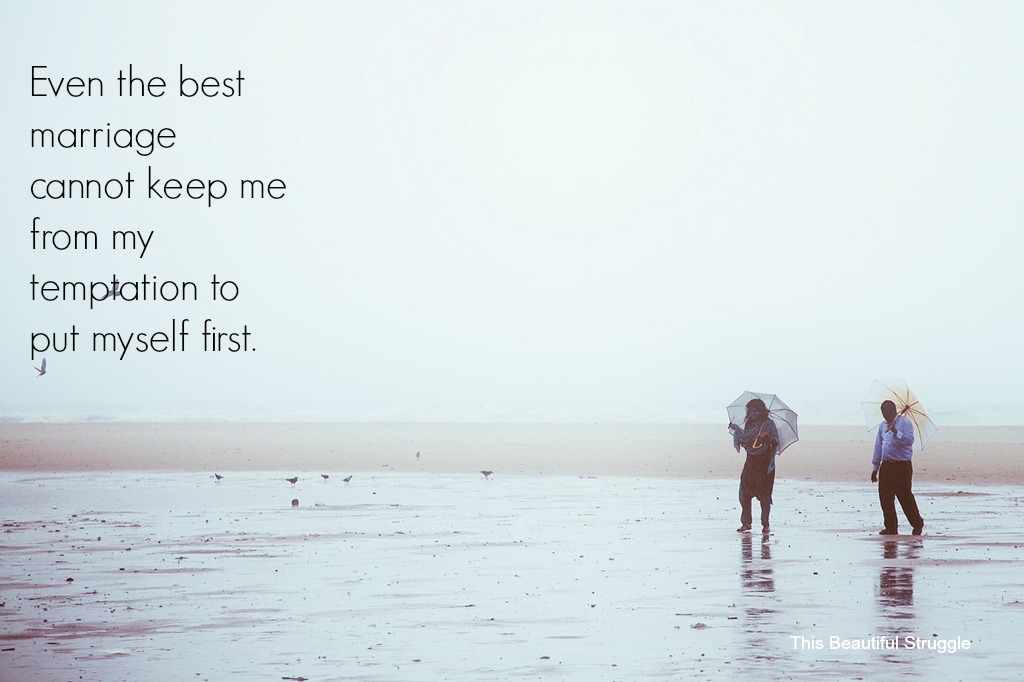
What scares the bejebus out of me is the fact that he cannot save me from my own sin*. No amount of love or devotion that he can offer me will ever give me the 100% guarantee that I’ll stop looking for approval somewhere else. Our nature seems to be bent toward gratifying our own desires (which might be why adultery seems to be the highest risk factor of divorce), and I’m no different than the rest of humankind. That thought, no matter how great the marriage, is sobering. Even the best marriage cannot keep me from my temptation to put myself first.
Original photo by VinothChandar via Creative Commons

Original photo by VinothChandar via Creative Commons

Instead, I must look to my responsibility for self-control. I have to wonder if adultery is the heightened version of a life already living for self-gratification, which seems to be the real problem. If so, far fewer marriages hit the rocks because of another woman and many more crack from the weight of getting what we want or the belief that we always should.

Marriage provides me an opportunity to practice daily the act of loving others as I love myself. When I stop looking at marriage as a way to fulfill me and begin to see it as a way to live with and love another, then I find myself fulfilled. But not without a lot of hard work and eating a little humble pie now and then. I suppose the key to happiness in marriage is finding a person who will lovingly wipe away those crumbs rather than shoving your face into a fuller bite.


*Sorry to use theological words. It’s the best term I could muster.

Of course I formed an opinion…

… and I think we need to calm the $%^& down. Seriously, fellow Christian-folk. Shhhh. Shhhhhhhhh. 

Yay for Phil, or whoever his name is, for “standing firm” in what he believes and not letting a Hollywood life, lived in the deep south, change him. 
BUT. I just saw this whole debacle framed as “preaching the gospel.” My friends, a stance on homosexuality is not the gospel. Telling others they are sinners is not the gospel. 
Jesus is the gospel. His life, death and resurrection is the gospel. The hope and love and joy and peace and all those other things plastered to our mantels this time of year – that’s gospel message. 
We want to be impressed when someone quotes some Bible verses because we believe it’s furthering our cause. Take a look at Jesus’ encounter in Matthew 4 – even the devil can quote a lick or 2 of scripture. I’m not calling Phil Whateverhisnameis “Satan.” I’m saying that mentioning a view, a chapter and a verse doesn’t give him permission to speak for all of Christianity. 
Ol’ Phil-ster will be just fine. He has millions of dollars. He’s not hidden away reading his illicit Bible in an underground cave for fear of his life. “Persecution” is a stretch. Instead he has cameras watching as he pulls out his leatherbound, perhaps duct-taped, beloved Bible. I’m sure Zondervan will start marketing a camo-clad version next week. He’ll be fine
But after our reaction, it’s the world that gives me pause for concern. How will we reach others with the beautiful news that God is With Us, especially in this season, with all of our whining of persecuted lives. Not getting to watch our favorite rednecks on our 42″ flatscreens hardly constitutes a hard life, and perhaps we should get off the couch and find out what the world really needs. 
#endrant
 

After the rain dance

Few occupations in the world have the built-in position of dependency on God quite like the farmer. When the rain comes, the crops grow. When drought appears, they don’t. But very little can be done to change which of two occurs on a given day or season. Most farmers fret and worry together, filling conversations with what their crops are currently doing and what they need in order to make the harvest worthwhile. 

Dad’s friend, C, no longer owns a rain gauge. “Ever since 1988 I stopped keeping one. There’s nothing I can do to put more rain in it.” 
My eyes just went buggy. 
At the end of the year, when the beans are cut and the corn is shelled, C knows within him that the crop is a direct result of what God did and provided, not necessarily his good work. Don’t get me wrong: the farmer’s job is to get the seed in the field. To make sure the ground is healthy. It’s all preparatory. And then to harvest when the plant is ripe. What actually grows, however, is out of the hands of the farmer. 
C’s rain gauge has changed the way I view an offering. 
Today I read Romans 12, a chapter that I could nearly recite by memory because I enjoy it and it retains a popularity due to the imagery.  “Offer yourself as living sacrifices…” usually comes partnered with the reminder that “living sacrifices can crawl off the table.” Thus we who offer ourselves up to God must continually choose to be there. 
But what if we didn’t put a rain gauge on our lives? What if our offerings – both of our time and talent, but also our checks and support – were a result of the realization that God did something, as opposed to the typical what we have to offer? What if we stopped looking at ourselves and our lives as something that we somehow made good in the first place? 
Later in the chapter, it says (MSG), “…it’s important that you not misinterpret yourselves as people who are bringing this goodness to God. No, God brings it all to you.” When we show up to fulfill our volunteer duties, when we make good on supplying educational bags for poor children, when we do our part to make sure the lights stay on and the pastor is paid, this isn’t our goodness. We might be portraying an element of obedience and faithfulness. But our offering isn’t from our goodness. It’s a reminder of God’s goodness that we even have something to bring. 
I imagine the farmers who for a few years had nothing to offer due to drought. But the year the rains came? He bundles up the first round and takes it to the temple. “See God? This is what you did this year. Thank you.” 
Take that in comparison to the farmer who surveys his crop and says, “Well, God, if you need it, you can have *this much* as I do enjoy coming here and I’d like to see a bigger feast.” 
The farmer without a rain gauge knows that it doesn’t matter how much is in there; what’s important is that God was good enough to send rain in the first place. His offering is a reflection of his gratitude, not an attempt make things right. His offering exemplifies God’s goodness, not his own. 
“The only accurate way to understand ourselves is by what God is and by what he does for us, not by what we are and what we do for him.” (12:3)
« Older posts Newer posts »

© 2026 Michele Minehart

Theme by Anders NorenUp ↑