Category: beautiful life (Page 15 of 35)

From Seed

We’ve always had at least a small patch of dirt to grow our tomatoes, our peppers, maybe a green bean or two. Last year we added cucumbers because JJ was determined to make a good clausen pickle – and he got very close. We’ve experimented with greens and broccoli, here and there. So, we’re not garden newbies.

Our new-to-us, for-nearly-one-year house came with a massive garden space. The plot had already been dug a few years ago, though when we moved in, it remained vacant. Last year we had to rely on farmer’s markets for anything fresh, and it would be an understatement to say that JJ’s disappointment in BLT season was massive.

So, this year we’re upping our game. Not only are we filling that vacant spot in the backyard, we’re starting it ourselves. That’s right. We’re growing from seed. And not just any ol’ seed packet from 3 years ago. We ordered heirloom packets from Baker Creek. We don’t mess around, no, we don’t mess around, nuh-uh. We purchased a few starter pots and a grow light, because we lack a good western-facing window.
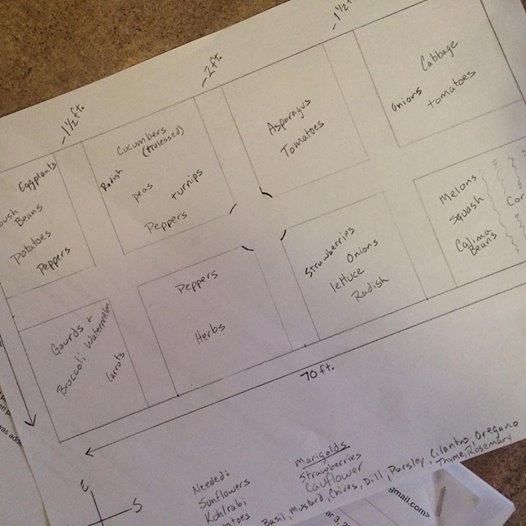
JJ's garden mapping. He even researched which plants grow best together.

JJ’s garden mapping. He even researched which plants grow best together.

We had the kids fill the little pots with the fluffy organic soil and I carefully doled out a few seeds per pot, and marked them with painters tape on the cup, because we lacked foresight to buy those little stick-things, and – let’s face it – the odds of those being removed and used as a weapon runs pretty high in this house.

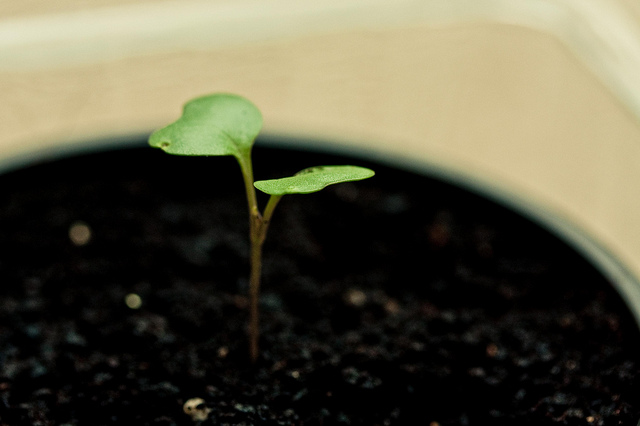
And then, we waited. And waited. Finally our onions (yes, onions! He thought he was getting starts, but no) gave us tiny slivers of green poking through the dirt. And then the tomatoes! We moved from the hotpad-prepped table to the light table. We even have alarms going off each morning and evening to remind us to water and move the pots around.

This growing stuff is serious business. We’re leaving overnight and have a little bit of concern about our sprouts. We check them regularly, and every time we see a new little stem, we celebrate. Right now, it’s a tad unfathomable what it will be like to pick a tomato that came from a plant that started as this teeny-tiny seed. There’s a certain amount of miracle, not only in our ability to keep these things alive, but in their inherit ability to grow and produce and to feed.

JJ said last night, “and just think about next year, after we collect the seeds from our own harvest and save them, and then start them again next year.” I think it’s akin what grandparenting might be like – watching this thing you grew, produce again and again.  You’re not at all in control, yet, without you, this life would cease to exist as we know it. We’re not the source. We can’t even “make” anything grow. Yet we’re vital to the entire process.

Of course, someone else, somewhere else, is growing perfectly “fine” little cherry tomatoes and banana peppers. We could always just let them do it. We can continue to go to the store and buy our imported romas, twice the size of the normal (because we Americans like everything “bigger and better”) and be on our merry little way.  Leaving it to the professionals is always an option.

When we continue to outsource, we don’t have to rearrange our lives. We don’t have to water and weed and pluck. And, for sure, you’re able to steer clear of the heartache of a bad season, a diseased favorite purple pepper, or the frustrations of a bug infestation. We can absolutely bypass the work of growth by buying it ready made. This is always an option.

So why do it?  And, as with gardening, so with life. Marriage, children, starting – or even working – a business. Why toil, strain and love?

I. Don’t. Know.

Except to say that in the process of growing something else, we reap a new kind of nourishment, one reserved for those who dig in wholeheartedly. This cannot be described with words, only by eating a tomato fresh from your garden. Or watching your child hit his first home run. Or standing beside your spouse as she accepts her Citizen of the Year award. Or hearing from a customer how you made her wedding the most beautiful day of her life. Or delivering yet another healthy baby. Or finding a donor to fund a cause that will change lives. Or helping someone find a home that will keep their family safe and warm, a respite from the world. Or helping a child write their first “book.”

There’s no reason to put in the hard work, other than the fact that hard work – whether it be with plants or people – blossoms and feeds you. It’s beautiful.

Obviously, I’m not mandating that every single person in the world must buy packets of seeds and set watering timers. This is simply our most recent peek into blessings of putting in the hard work. It helps me to answer the “why.” Why we don’t watch a ton of TV. Why we opt to bake bread instead of letting McDonalds fry it for us. Why we rearrange schedules so we can be with friends. Why we move to a small town for a lesser-paying job in exchange for nearby family.

We do hard things because they are good. Perhaps even better than easy things. Hard things give us a new sense of life and the enjoyment of it. There’s a certain beauty at discovering the connection between your soul and the rest of the universe. With a little love and attention, we can be a part of the process of creation, not just the consumption.

“Very truly I tell you, unless a kernel of wheat falls to the ground and dies, it remains only a single seed. But if it dies, it produces many seeds.” (John 12:24)

Easy Peasy

Let’s begin by saying: I love my washing machine. It’s fantastic. I put the clothes in, add some detergent, and 40 minutes later (or when I remember to check), they’re clean. This is far superior to pumping water into a large vessel and scraping the clothing across a metal board, nicking my knuckles and breaking a sweat. I love my washing machine because it makes my life easy.

Easy can be a good thing. I’m thrilled I don’t spend Wednesdays at a washing board.

Yet why do we believe easy is always the goal?

While discussing the new year and “new you” many people approach in January, my friend Trevor reminded us how challenging it is to make change. Basic physics reminds us that an object at rest remains at rest. The easiest thing you can do is stay the same.

My friend Wyatt reminded us nearly everything in our culture tries to convince us that easier equals better. We try to make washing machines out of everything. This is why George Takai has a job pointing out ridiculous user reviews on things like banana slicers. We think there has to be an easier way to do everything because easier is always better. We spend nearly as much time and energy concocting plans to make things easier rather than simply doing the work.

Under the belief that easy equals better is a belief that easy means you have time and energy to spend doing other things. I’m at my computer instead of a washboard. So this can be quite advantageous – until we run out of real things to do. Our culture worships the idea of easy because we feel so stressed and hurried that we can hardly get it all done. And when we finally get our ready-made dinners microwaved and bananas sliced and clothes tossed in the washer, what do we do with our time? I can only speak from the experience of my household, and it starts with the letter T. and ends with V. I don’t play with my children more when I don’t have to wash my clothes; I find ways to waste my otherwise precious time.

I think we’re restless looking for ease when we don’t accomplish anything meaningful. So we look for new ways of entertaining ourselves, which could be made even easier. You can take up knitting,  and buy one of those rings so you don’t have to bother learning how to hold the needles. You can read a book and never have to turn a page. You can bake cookies but not bother making a dish dirty by simply slicing and baking. Even our leisure has fallen to the tyranny of the easy as opposed to simply enjoying the beauty of the work.

Work is not a bad thing. Perhaps your job isn’t great or you don’t like your boss, or the industrialization of everything makes your work monotonous and mundane. But that’s not the fault of work. We were created to be a part of something bigger than ourselves and I believe God gave us each a little corner of the world to care for and steward. Perhaps that’s a cause, a family, a piece of land or a tangible good that makes people’s lives better and brighter. At times, the work of caring for that corner might be hard. But it is also good.

My friend, as you embark on a new year with new goals, may you not find the easy way out. May you do the hard work now and reap the benefits of finding meaning in your success.

Invisible Work

At some point, long ago, JJ and I had a discussion on household labor, in the midst of which, I asked him if he believed he had a personal Drinking Glass Fairy. Every night the man fills a glass of water and sets it on his bedside to quench his middle-of-the-night thirsts. Yet, when he would arrive the following night with a fresh glass of water, the glass from the night before would have mysteriously vanished. Sometimes, I will admit, the fairy was tired and the night-before-glass only made it as far as the bathroom countertop.

It’s not necessarily his fault that he had never considered how the glasses magically moved from bedside to kitchen – let alone from countertop, to dishwasher, to cupboard, to table and back to dishwasher again. These things happen in an invisible fashion.

This is the nature of most of my work: invisible work. In a day’s time, I can complete a lot of work, none of it noticeable unless I suddenly stop doing it. Laundry magically appears fresh and clean, meals materialize out of no where, the pantry holding the contents for everyone’s favorite snack (unless, however, I forget).

It could be the nature of my current situation, the work of home tending, which makes it seem so invisible. Have no overseer, no boss with the power to fire me (believe me, I’ve tried). But  most workplaces have their own version of invisible work, too. Those meaningful questions for students don’t magically appear without the invisible work of pedagogy; sales ride the tails of the invisible work of understanding human nature and connecting with needs and wants. We all have our own version of the work no one notices unless it’s left undone.

We’re coming off a season of the most intense invisible work of the year, IMHO. The understanding of our loved ones, the seeking out of perfect embodiments of our feelings and appreciation – this happens behind the scenes.  Then – and let us all bend our knee – the Amazon Prime begins to happen. These little elves run a website so full of invisible miracles, and then with 1-Click powers and the Holy Spirit of UPS, brown packages arrive on our doorsteps in two days or less. If you want to talk about invisible work, let’s salute the gal (or guy) who decides how each truck, train and plane will move about the goods for the Man in Brown to deliver.

My friend Abby told me last year she had stayed up late on Christmas Eve, staging the scene, making a magical Christmas morning for her children. I was in awe (and a little dumbfounded – my Aim Low Parenting approach kept me from ever really considering what the living room looked like). Thanks to her invisible inspiration and a little of our own invisible work, I watched my oldest creep out to the living room in the early hours and, by the light of the Christmas tree, examine the evidence of Santa’s visit. It was a moment made for movies. Of course, he would have found the moment magical even if I hadn’t stood the gifts on their side as opposed to stacking them and shoving them under the tree. These bits of invisible work make our lives better, brighter and more beautiful.

And now, today, we return to the invisible work of feeding people meals and finding receipts and refereeing children. Know this, my friend: though the work seems invisible, you are not. I know, no matter how effortless you make it appear, the thought, the heart, even the sweat that goes into making your invisible work transform your home, work and relationships.

« Older posts Newer posts »

© 2026 Michele Minehart

Theme by Anders NorenUp ↑